From Ideas to Action: How to Systematically Apply AI in Industry

Author: Elo Gaver

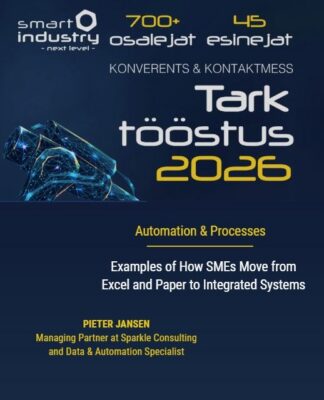
Tark Tööstus 2026 is the largest industrial event in Estonia. It brings together manufacturing companies, technology providers and leaders responsible for development and digitalisation. In a time of rapid change, companies face a key question. How can artificial intelligence create real and measurable business value?

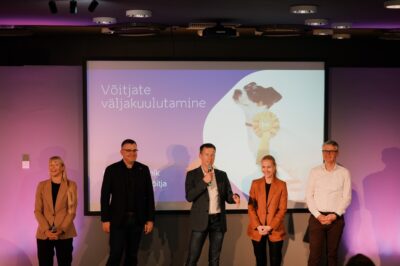
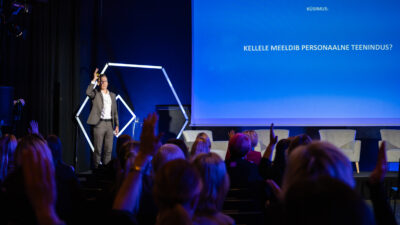
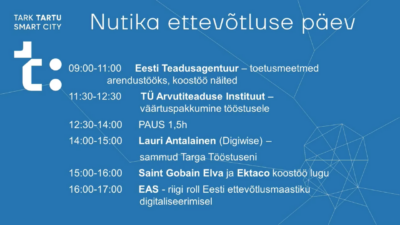
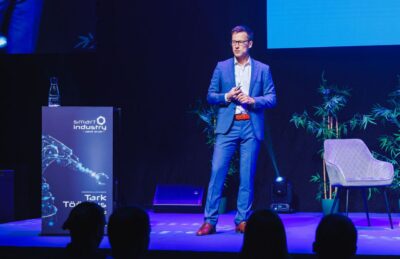
At the conference, Digiwise founder and digitalisation expert Lauri Antalainen will lead a workshop titled “From Ideas to Action – How to Systematically Apply AI in Industry.” The session focuses on AI from a management and business perspective.

The workshop highlights common mistakes companies make when applying AI. It also introduces a structured approach that helps move from isolated experiments to a clear action plan. Participants learn which use cases to prioritise and how to build a practical roadmap. By the end of the session, they will have an initial plan for applying AI in their own organisation.

EIS Digital Mentoring: Practical Support for Digitalisation in the Tourism and Creative Sectors

Author: Elo Gaver

The EIS digital mentoring programme is designed for companies in the tourism and creative sectors that want to better understand their level of digitalisation and make informed decisions about their future development. During the programme, companies work with an experienced mentor-consultant to map business processes, identify bottlenecks and opportunities, and develop a digitalisation roadmap for up to three years.

Digiwise consultants contribute to the seminar programme with different areas of focus: Lauri Antalainen addresses digitalisation as a whole and helps companies define their digital roadmap and strategic choices, while Olga Luštšik focuses on practical examples and the specific needs of tourism and creative businesses.

The information seminar will take place on 18 March 2026 from 14:00 to 16:00 at the brand-new Novotel Tallinn hotel (Pordi 5, Tallinn).

Participation is possible both on-site and via Zoom, and the event is free of charge. During the seminar, mentor-consultants will introduce the principles of digital mentoring, explore digitalisation opportunities, and present sector-specific digital roadmaps, highlighting their practical business value.

Registration is open HERE and you can learn more about the programme HERE (in Estonian).

PRIA Investment Support for Rural Businesses: Up to €200,000 to Strengthen Competitiveness

Author: Olga Luštšik

If a company operates outside major cities and plans to invest in technology, automation or resource efficiency, it is worth exploring the PRIA investment support measure aimed at increasing the competitiveness of rural businesses.

As of 1 February 2026, updated conditions apply. The changes are designed to make the support accessible to a wider range of rural entrepreneurs.

What is supported?

The measure is aimed at businesses that operate permanently in rural areas and wish to improve their competitiveness. Support can be applied for:

  • the acquisition of tangible assets (e.g. production equipment, automation solutions, IT infrastructure);
  • the acquisition of intangible assets (e.g. software, licences and digital solutions);
  • the construction of a building at the applicant’s permanent place of business in a rural area.

Key conditions of the support

  • Support amount: €10,000–€200,000 per applicant during the entire period
  • Support rate: up to 65% of eligible project costs
  • The support is granted as de minimis aid, with a ceiling of €300,000 over three years

Who can apply?

Companies are eligible if:

  • their place of business is located in a rural or small urban settlement area (excluding municipalities bordering Tallinn).

The exact definition of rural areas is available on the PRIA website.

Important detail: job creation requirement

When applying for support for tangible assets or construction works, at least one new full-time position must be created as part of the project. The job must be located on the same property where the asset is installed or the building is constructed.

There is no job creation requirement when applying for support for intangible assets, such as software or digital solutions. This allows companies to focus on digitalisation and process improvement without additional staffing obligations.

For more information, visit the PRIA website.

Digiwise helps assess whether the measure is suitable and, if needed, supports the preparation and submission of the funding application.


Olga Lustsik (Olga Luštšik) is an Estonian digitalization and AI consultant with 15+ years of product development leadership experience. She advises SMEs on business process optimization, digital transformation, and AI adoption.

Digiwise in Vilnius: How AI Is Transforming the Business Landscape

Author: Elo Gaver

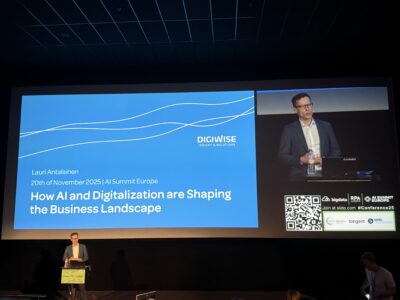
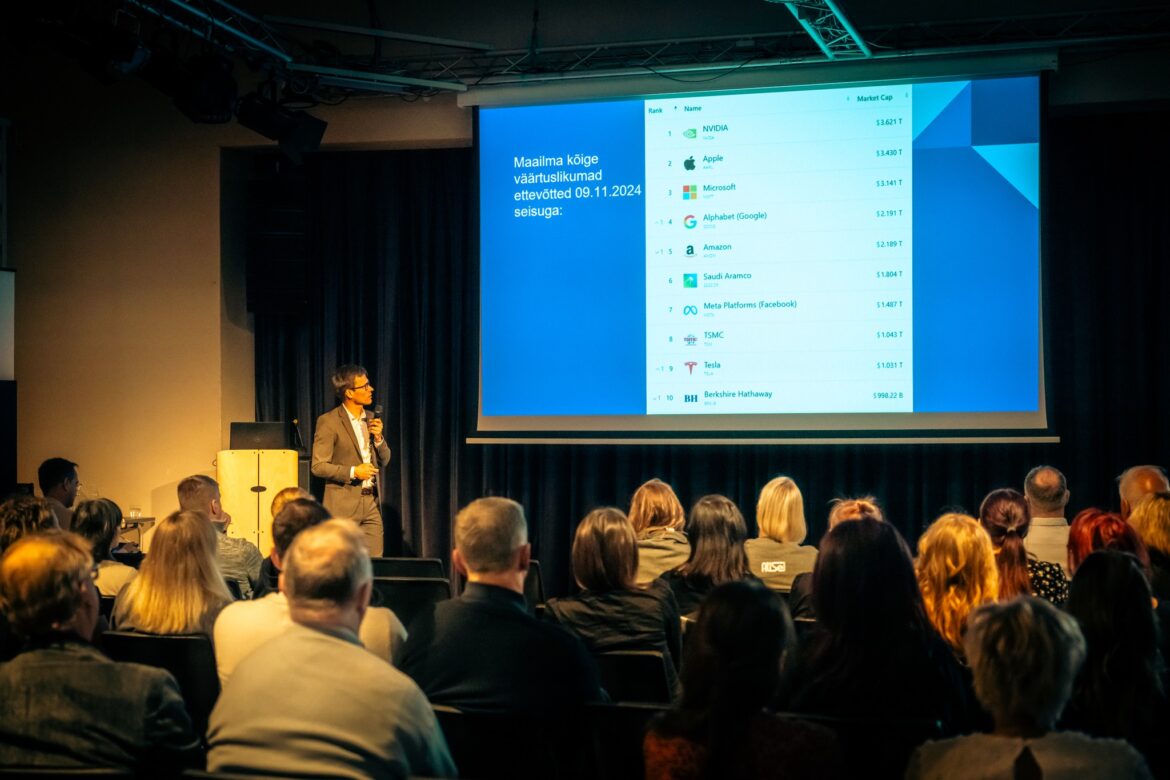
In November, Digiwise’s Lead Consultant Lauri Antalainen participated in AI Summit Europe in Vilnius, where he delivered a keynote titled “How AI and Digitalization Are Reshaping the Business Landscape.”

The presentation brought together real-life examples from both Estonian and international companies, showing how the use of artificial intelligence and digitalization has helped reduce hidden inefficiencies, increase productivity, and make business models more future-proof.

In his presentation, Lauri Antalainen focused on three key questions that help companies understand where and how to apply AI most smartly:

• How does AI change the way we conduct business, and what does that actually mean?

Artificial intelligence has long since stopped being a “new tool.” When used skillfully, it accelerates decision-making, reshapes processes, and changes the logic of competition. Companies that apply AI purposefully inevitably move forward more quickly.

• Which inefficiencies should companies target first with AI?

The highest hidden costs typically arise in processes that are repetitive, slow, dependent on manual labor, or prone to errors and waiting times. These are exactly the types of bottlenecks that can be eliminated through AI-powered digitalization.

• How to apply AI strategically — not just experimentally?

Using AI does not mean simply turning on a new program. Before implementing changes, companies need to identify bottlenecks, assess the value the solution will bring, design a more efficient workflow, and measure the results of the change.

The message was clear and role-specific:

  • If you are an employee, learn to use AI tools, or risk having your work done by someone who does.
  • If you are a business owner or leader, assume your team already uses AI (because they do). Your task is to build processes where AI can increase the value of the company.
  • If you are a B2B service customer, assume your service providers use AI, and use that insight to renegotiate prices.

AI Summit Europe demonstrated convincingly that artificial intelligence is no longer a “topic for the next decade,” but a practical tool and competitive advantage today. Digiwise had the opportunity to share its experience and bring real Estonian digitalization and AI use cases to the stage.


Practical Digitalization Examples for the Tourism Sector: Digiwise’s New Educational Videos on the Visit Estonia Platform

Author: Elo Gaver

The tourism sector — like all other industries — is in constant transformation. Digitalizing services, using data intelligently and automating processes are becoming increasingly important. To help companies take purposeful steps on their digital journey, Digiwise consultants, Visit Estonia, and the Estonian Business and Innovation Agency (EIS) have created a six-part series of practical educational videos.

The production of the videos was supported by the European Union to help tourism companies increase their level of digitalization and reduce manual data entry.

1. Why is it important to collect high-quality data from business processes?

In this video, Lauri Antalainen explains why data is essential for the growth of a tourism business and how it is transformed into information, knowledge, and ultimately, wisdom.
The video explains the difference between operational and decision-making data, the stages of data value creation, and offers practical advice on how to start systematic data collection.

YouTube (in Estonian, 7 min): Lauri Antalainen — Why is it important to collect high-quality data?


2. How to plan digitalization and evaluate its success?

The goal of digitalization is not simply to implement new software but to achieve real business change.
This video explains how to set meaningful goals, plan the stages of a digitalization project, and measure the actual impact on the company.

YouTube (in Estonian, 7 min): Lauri Antalainen — How to get started and how to ensure your digitalisation was successful?


3. Managing reservations in accommodation businesses

Manually managing accommodation bookings causes confusion, double bookings, and unnecessary workload.
The video shows how property management systems can automate reservations, reduce the risk of errors, and improve the guest experience.
Olga Luštšik also highlights the importance of integrating these systems with accounting, POS solutions, and online platforms.

YouTube (in Estonian, 6 min): Olga Luštšik — Managing reservations in accommodation businesses


4. Upselling additional services and guest check-in

Olga Luštšik maps out common bottlenecks throughout the guest journey — from booking to entering the room.
The video presents automation opportunities at different stages and introduces key solutions such as HotelBuddy, Salbos, Bouk, Duve, and Oaky.
It also demonstrates how to calculate the impact of upselling on revenue and time savings.

YouTube (in Estonian, 6 min): Olga Luštšik — Upselling additional services and guest check-in


5. Five most common problems in document management

In many tourism businesses, documents are stored on employees’ computers, in emails, on paper, or simply in people’s memory — leading to risks and confusion.
In this video, Olga Luštšik explains how cloud-based document management makes work more secure, faster, and more transparent, and what tools tourism companies most commonly use.

YouTube (in Estonian, 7 min): Olga Luštšik — Five most common document management problems


6. Room rental and increasing occupancy

Why do seminar rooms, saunas, or gym spaces often remain unused?
In this video, Olga Luštšik explains how self-service options, automated booking, and accommodation management systems can increase the sales of additional services, reduce manual work, and improve occupancy rates.

YouTube (in Estonian, 6 min): Olga Luštšik — Why do my seminar rooms stand empty?


Digiwise is ready to support tourism companies that wish to begin their digitalization journey or give an extra push to processes already underway.
If the topics covered in these videos resonated, Digiwise can help assess opportunities and support the planning and implementation of digitalisation initiatives.

Digiwise at Leadership School Armenia: Systems Thinking in Practice

Author: Elo Gaver

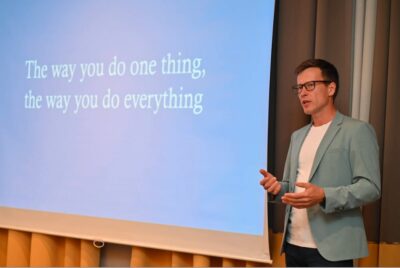
In early October, Lauri Antalainen, Founder of Digiwise and President of EstBAN, encouraged future leaders in Armenia to think systematically — both in work and in life.

Based in Armenia, Leadership School is a politically and religiously independent foundation dedicated to developing the next generation of leaders. Great importance is placed on involving both local and internationally recognized experts in shaping future changemakers.

In his presentation, Lauri Antalainen spoke about systems thinking — a way of viewing an organization as a whole, comprising interconnected parts. It was another great opportunity to combine his work at Digiwise and EstBAN, sharing insights from his experience in investment and business consulting.

He emphasized the importance of systems thinking and shared valuable lessons from both personal experience and client feedback — showing how a structured approach helps create consistency, reduce risks, and increase efficiency.

According to Lauri, the benefits of consistency and clear processes are multifaceted:

  • work is done the same way every time, reducing complexity and errors;
  • results become more predictable and stable;
  • activities can be scaled and replicated more easily;
  • time waste is reduced, and efficiency increases;
  • quality control becomes simpler and more transparent;
  • new employees learn faster, and accountability is clearer.

He also reminded the audience that “doing small things takes just as much time as doing big things” — meaning it’s worth focusing on the steps that have the greatest impact on the whole system.

By participating in Leadership School, Digiwise contributes to the global dialogue on digitalization, leadership, and innovation — building bridges between Estonia’s business ecosystem and the next generation of future leaders.

Digiwise at AI Summit Europe: Eliminating Inefficiencies with AI

Author: Elo Gaver

In November, Digiwise will participate in AI Summit Europe in Vilnius. This is a highly anticipated event for all enthusiasts of artificial intelligence and digital transformation.

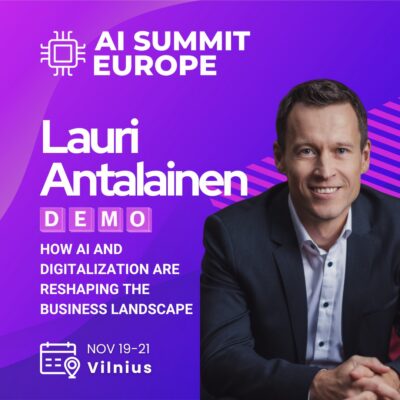
Digiwise’s lead consultant Lauri Antalainen will deliver a demo session titled “How AI and Digitalization Are Reshaping the Business Landscape.” In his presentation, he will share practical experiences and examples from different industries and countries. Over the years, he has developed expertise in identifying hidden inefficiencies and transforming workflows in organizations of various profiles, using the power of AI and automation.

Attendees will gain practical insights into:

  • the most common sources of inefficiency in business processes;

  • effective methods for addressing them with AI and automation;

  • the broader strategic benefits this brings for productivity and competitiveness.

As Lauri says in his short video message: “If you want to see techniques and practical examples of how to eliminate inefficiencies with AI and digitalization – come join my session. See you in Vilnius!”

We are excited to share Digiwise’s perspective at AI Summit Europe and to show how digitalization creates real value for businesses.

Digiwise in Yerevan: at the crossroads of investors and the technology sector

Author: Elo Gaver

This autumn, Digiwise has the opportunity to visit Armenia not once, but twice. Yerevan is hosting both Gateway to Europe and Digitec. Both events bring together investors, technology experts, and entrepreneurs from around the world, offering a platform for knowledge sharing and new connections.

Held in September, Gateway to Europe unites Armenian and European angel investor networks (STAN, EBAN, BANA, AICA) that seek out and support early-stage technology startups. Lauri Antalainen, Founder of Digiwise and President of EstBAN, will represent the Estonian business angel community there and share his insights on how artificial intelligence and digitalization can accelerate the growth of startups.

In October, Digiwise will take part in Armenia’s largest technology conference, Digitec. Celebrating its 20th edition, this year’s event focuses on:

  • cutting-edge AI technologies and deep tech innovations,

  • strategies to help companies achieve global growth,

  • venture capital trends and startup funding strategies.

Lauri Antalainen, who in addition to leading EstBAN also serves on the Advisory Board of Latitude59 and has invested in more than 50 startups, will share his perspective at Digitec both as an investor and as the founder of Digiwise. In his talk, he will highlight how artificial intelligence and digitalization help companies identify inefficiencies, build competitive advantages, and prepare for international growth.

Taking the stage in Yerevan is a recognition that Digiwise is confidently moving at the intersection of investors and technology – both in Estonia and beyond.

Digiwise at ICT Week Uzbekistan: Thoughts on Supporting Digital Transformation at the National Level

Author: Elo Gaver

ICT Week Uzbekistan is the country’s largest and most significant IT event, held annually since 2004. The week brings together diverse conferences, workshops, and exhibitions, offering an excellent platform for exchanging experiences and showcasing new technologies. It also provides ideal opportunities to present Uzbekistan’s IT sector to foreign investors and to strengthen cooperation between the state, businesses, and consumers.

Lauri Antalainen, Founder of Digiwise, has been invited to speak at the event about artificial intelligence and to discuss how governments can support digital transformation. Against the backdrop of rapid population growth and urbanization, AI offers solutions that make life smarter, more efficient, and more inclusive.

In his talk, Lauri Antalainen will share ideas on how governments can support digital transformation, for example by:

  • creating standards, knowledge bases, and education programs,

  • bringing in knowledge from abroad,

  • promoting AI and digitalization through associations and federations.

In addition to being the Founder of Digiwise and the President & Board Member of EstBAN, Lauri Antalainen is also a member of the Committee on Artificial Intelligence and the Brain at the Estonian Academy of Sciences. This gives him a broad background in entrepreneurship, business growth, and venture capital.

We are delighted that Digiwise can share its perspective on the international stage – and then return home to Estonia with fresh insights for future action.

Tippinnovaatorite (“Top Innovators”) program’s 3rd group final event at Tallinn TV Tower: Innovative Mikskaar and Verston Eesti!

Autor: Elo Gaver

On June 12th, the final event of the 3rd group of Tippinnovaatorite took place at the Tallinn TV Tower, where Mikskaar was crowned the winner. Mikskaar is a company developing an environmentally friendly growth substrate, replacing peat with wood-based peat made from local wood industry waste.

Mikskaar’s Miksgrow solution combines environmental sustainability with precision agriculture, using real-time soil moisture measurement data to make precise irrigation and fertilization decisions.

The public’s favorite was Verston Eesti, whose goal is to become the most environmentally friendly infrastructure company in Europe. To achieve this, they are bringing more digitalization, electrification, and automation to the sector. Lauri Antalainen, a member of the Tippinnovaatorite jury, happily noted that Estonia has tremendous potential to create world-changing innovation. Congratulations to all participants and supporters, especially Mikskaar and Verston Eesti!

The Estonian Academy of Sciences’ New Commission: Developing Artificial Intelligence and Strategic Steps

Autor: Elo Gaver

At the beginning of May 2025, the Estonian Academy of Sciences (EAS) established the Artificial Intelligence and Brain Commission, with the aim of guiding the development of Estonian science and technology in the field of artificial intelligence. The Commission focuses on solving important scientific and applied issues for the state, including the implementation of artificial intelligence, the development of scientific research, and the support of innovation.

A key task of the Commission is to act as a bridge between basic and applied research, providing valuable advice to the government, parliament, and the public on scientific and technological matters. Lauri Antalainen, Lead Consultant at Digiwise, is responsible for AI implementation in industrial enterprises and plays a crucial role in offering strategic advice. The Commission includes 17 members, specialists from various fields.

At the first meeting, the Commission discussed the impact of AI on the economy and society, the need for advanced AI and IT infrastructure, and the importance of reducing Estonia’s dependence on global cloud service providers such as Microsoft, Google, and Amazon. The discussion also highlighted how national funding for scientific research can support AI development and ensure the preservation of the Estonian language and culture in AI applications.

The Commission aims to define strategic paths for applying AI solutions across sectors like the economy, education, healthcare, and security. They discussed how AI can transform industrial processes, improve education, and enhance public services. Members agreed that AI development in Estonia must address both technological needs and the development of human competencies, with universities playing a key role.

The Estonian Academy of Sciences continues to support science and innovation by shaping policies focused on AI development and its impact in Estonia.

Innovation Leaders Club: AI – Not a Goal, but a Tool

Author: Elo Gaver

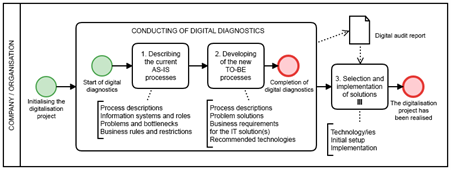
On May 28, the Innovation Leaders Club held its latest meeting focusing on how to apply artificial intelligence (AI) in business. The event was opened by Lauri Antalainen, a member of the club’s advisory board and the co-founder of Digiwise. In his keynote, he emphasized that AI should not be treated as a goal in itself. Instead, it should be seen as a chosen tool that enhances human actions. To begin with, organizations should map their current processes (as-is), outline their desired future state (to-be), and define a specific business task. Only then can they choose the right AI-based solution or partner.

Sandra Reivik, a consultant at Digiwise, shared three principles that will help turn AI into real value: a shift in mindset, curiosity, and the ability to use AI consciously. According to her, AI is not going away — it is becoming a natural part of everyday work. That’s why it is important to create internal focus groups, encourage experimentation, and build awareness and readiness across the organization. AI is not just an IT matter — it’s a team effort.

Throughout the event, one clear message stood out: AI won’t replace people, but people who use AI will soon replace those who don’t. When applied thoughtfully, AI can improve workflows, boost efficiency, and enhance the customer experience. But to get there, we need to engage with technology as consciously as we do with people — by starting with needs, asking smart questions, and learning step by step.

Updated Digital Solutions at Tourism Company Tiit-Reisid


Author: Elo Gaver

Last year, the tourism company Tiit-Reisid, based in Hiiumaa, went through a generational shift. The founder passed leadership to his son, Raido Randmaa, bringing fresh energy alongside years of experience. Having been close to the company since its beginning, Randmaa saw the move as a natural next step. From the outside, it may have seemed surprising — leaving a top position at Estonia’s largest infrastructure company to return to his roots in Hiiumaa and step into the tourism industry.

Although the business operations were familiar, Randmaa was surprised by the overall low level of digitalisation in the tourism sector. Tiit-Reisid had a functioning website, online store, and booking system, but managing data still involved a lot of manual work. This led to errors, wasted time, and unnecessary effort.

To bring clarity and structure, Tiit-Reisid joined the Visit Estonia digital mentoring programme. Together with Olga Luštšik, Senior Consultant at Digiwise, they mapped the customer journey, internal processes, and data flow. The result was a comprehensive and actionable digital roadmap, including 42 specific steps to guide the company over the next three years.

“I feel that I’m in the right place, doing the right thing,” Randmaa said. “The support and mentoring from Digiwise helped me see the big picture and make smarter choices.”
He added that some of the tasks from the roadmap will already be completed before the end of the year.

“Work Smart, Not Hard”

Autor: Elo Gaver

Under this theme, a series of educational seminars took place in collaboration with the Estonian Hotel and Restaurant Association, HotelBuddy, Visit Estonia, and D-EDGE Hospitality Solutions. The aim was to help hotels keep up with industry trends and discover new ways to improve their daily operations.

The seminars focused on digitalisation and automation in hospitality. Speakers shared practical tips and real-life solutions for making everyday work more efficient and for improving the guest experience.

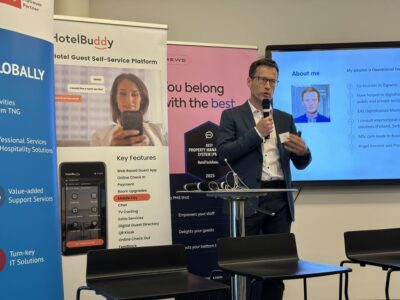
One of the keynote speakers was Lauri Antalainen, Lead Consultant at Digiwise. His talk, “Where to Begin and What Are the Benefits?”, offered a clear and hands-on guide to starting a digital journey. He explained how to build a step-by-step roadmap and make changes in a structured and successful way.

Events like these show that Estonia’s hospitality sector is ready for innovation and open to collaboration. Digiwise is grateful to the organisers for their trust and looks forward to taking the next steps together with tourism professionals across the country.

Visit Estonia Info Day: How Can Estonian Tourism Grow Sustainably and Efficiently?

Author: Elo Gaver

Just before the start of the new season, EAS and Visit Estonia hosted an inspiring and informative info day for tourism professionals at the PROTO Invention Factory in Tallinn. The event was divided into three main parts: an overview of Estonian tourism and Visit Estonia, insights into key target markets, and a discussion on sustainable management and digital waste.

The first part focused on the history and future of Estonian tourism. Updates were shared about Visit Estonia’s online platform and team, as well as the “Tourism Act” competition – a major initiative supporting the development of tourism in Estonia.

The second part gave a closer look at research on target markets. Are German tourists planning trips to Estonia? Is the average UK tourist quirky or traditional? What happened to the Swedish connection, and how do we best connect with Finnish travellers? These and other questions were addressed by Visit Estonia experts, who shared up-to-date insights and fresh analysis.

The third part tackled the theme of sustainability and resource efficiency for companies and organisations. The session included an economic outlook from a business analyst on Estonia and the surrounding region. Hestia Hotel Group presented its sustainability initiatives, and speakers shared real-life stories from the hospitality sector. A key highlight was Lauri Antalainen from Digiwise, who offered practical tips on how to avoid digital waste and operate more efficiently.

The event offered participants valuable knowledge and hands-on solutions to help Estonian tourism not only grow, but do so sustainably and with digital efficiency. One of the main takeaways was how digital technologies can help reduce waste and make tourism services more eco-friendly. Together, the discussions laid the foundation for a more sustainable and innovative future for Estonian tourism.

First Place in the Supreme Court Case Competition!

Author: Elo Gaver

Geia Rõivas, a graduate of Miina Härma Gymnasium, took part in the Supreme Court’s case competition for the third time this year. The competition gives students interested in law the chance to solve real-life court cases and contribute to justice.

Geia had already earned second place and special prizes from the Ministry of Justice and the Supreme Court in previous years. However, first place had always remained out of reach. This year, picking the right case and solving it skillfully was a bigger challenge than ever. As the saying goes, “Measure nine times before you cut.” Geia’s first choice was a criminal law case, which she and her mentor had carefully discussed. But just days before the deadline, she decided to switch to an administrative law case, making a bold last-minute change.

This decision turned out to be the key to her success. By trusting her instincts and focusing on a politically relevant case, Geia was able to win. The Supreme Court recognized her strong reasoning skills by awarding her first place with a certificate at the competition held for the Court’s 105th anniversary.

Geia reflects on her experience: “Having participated in the competition several times, I encourage all high school students interested in law to get involved. It’s a great way to see if law could be the right career for you. The competition has opened my eyes to new perspectives and broadened my worldview. For example, this year I gained a deeper understanding of the Israel-Palestine conflict—an issue that helped me grasp the complexities of international law and geopolitics.”

Geia Rõivas was once again guided by her former teacher, Elo Gaver, the assistant manager of Digiwise.

County Development Centers’ Digitalization Training – A Step Towards the Future

Author: Elo Gaver

In the autumn of 2024, the County Development Centers (MAKs) partnered with Digiwise OÜ to launch a digitalization training program aimed at increasing business owners’ awareness of how digital technologies can enhance business processes. The training was led by Lauri Antalainen, who has extensive experience in delivering practical training on digitalization and automation topics.

Digitalization – Where to Start?
The first module focused on identifying losses and waste in processes. Participants quickly realized that the biggest obstacles to effective work in businesses were fragmented, inaccurate, or poorly structured information flows. Lauri Antalainen highlighted various forms of digital waste during the training, including:

  • Manual data entry and double processing
  • Excessive communication and information overload
  • Inefficient use of time and unoptimized processes

The second module addressed improving processes through standardization and automation. Broadly speaking, companies have the opportunity to improve workflows through standardization, digitalization, and automation. Common solutions include the adoption of e-invoices and the digitalization of work orders. The training also covered robotic process automation in businesses, where repetitive manual tasks can be entrusted to software robots.

Real-Time Economy and Data Quality
The third module focused on real-time business solutions, allowing companies to make data-driven decisions without delay. The main advantages of these solutions include secure and automatic data flow, machine-readable e-invoices and delivery notes, as well as the use of relational databases and registries.

During the training day, participants discussed how data quality and structure impact decision-making processes within companies. In a practical exercise, they analyzed which registries were necessary for their work and how existing data could be used more efficiently.

Making the Right Choices in Implementing Digitalization Projects
The fourth and final module was focused on planning digitalization projects and conducting cost-benefit analyses. Companies received guidance on how to choose the right software solutions for their needs, how to develop a digitalization roadmap, and how to calculate the return on investment for digitalization.

Lauri shared examples where companies replaced outdated ERP systems with newer solutions that better met their changing needs.

This practical training program gave participants a clear overview of digitalization opportunities, along with actionable tips. It became evident that digitalization is not just a passing trend but an essential step for staying competitive.

Key Takeaways from the Training Sessions:

  • Mapping and optimizing processes is the foundation of digitalization.
  • Data quality determines the success of digitalization.
  • Choosing the right tools and software helps avoid large costs and failed projects.

The County Development Centers’ initiative to offer such training is a crucial step in advancing digitalization and enhancing the competitiveness of Estonian businesses.

Läänemaa Business Conference “Business in the Digital Age” – The Future of Business is Here

Author: Elo Gaver

On November 14, 2024, the Läänemaa business conference “Business in the Digital Age” took place in Haapsalu.

Digitalization and artificial intelligence have arrived to stay, and the goal of the event was to raise business owners’ awareness about digitalization and the skillful application of artificial intelligence in modern business. Speakers provided a wealth of practical knowledge and shared their experiences, inspiring attendees to think big about what businesses have already achieved.

Throughout the day, speakers repeatedly emphasized that digitalization is no longer just a trend—it is a crucial step for maintaining and increasing competitiveness. Manufacturing companies, in particular, can automate and optimize various stages of the production process through digitalization, which in turn helps reduce costs. With the ability to collect and analyze data in real-time, businesses can be managed more efficiently.

One of the speakers, Lauri Antalainen, a lead consultant at Digiwise, highlighted how the application of artificial intelligence in production can predict maintenance needs, optimize supply chains, and improve quality control. He also addressed the burning question: “Will artificial intelligence take away our jobs?” Lauri believes that AI can complement human work, as its purposeful and thoughtful use helps businesses improve efficiency, innovation, and competitiveness.

Alise Technic OÜ shared their experience in the field of digitalization. They faced the challenge of manually processing orders, which took seven minutes per order. This became too time-consuming for the company, so they developed a platform to automate the order process. As a result, the company saves over 600 hours of manual work annually and reduces the possibility of errors during order entry.

The conference also introduced the much-anticipated BellaBot, a robot presented by Jana Valliste from Roborent OÜ. BellaBot served as a living example of how automated solutions can enhance service processes and improve efficiency across various sectors.

Conference participants were reassured that, when used skillfully, artificial intelligence can be a helpful companion, not a rival. It saves time and money, enabling businesses to focus on what truly matters—innovation, growth, and better customer service.


Tartu Entrepreneur of the Year Awards: Digiwise Clients Among the Nominees

Author: Elo Gaver

Since 1998, the city of Tartu has been recognizing the best entrepreneurs. The competition is based on economic indicators submitted by all registered companies in Tartu and the Tartu County to the Business Register by the required deadline.

Based on the results from the previous fiscal year, Tartu’s top entrepreneurs were invited to the recognition gala. Digiwise is pleased to highlight three companies that were honored at the event:

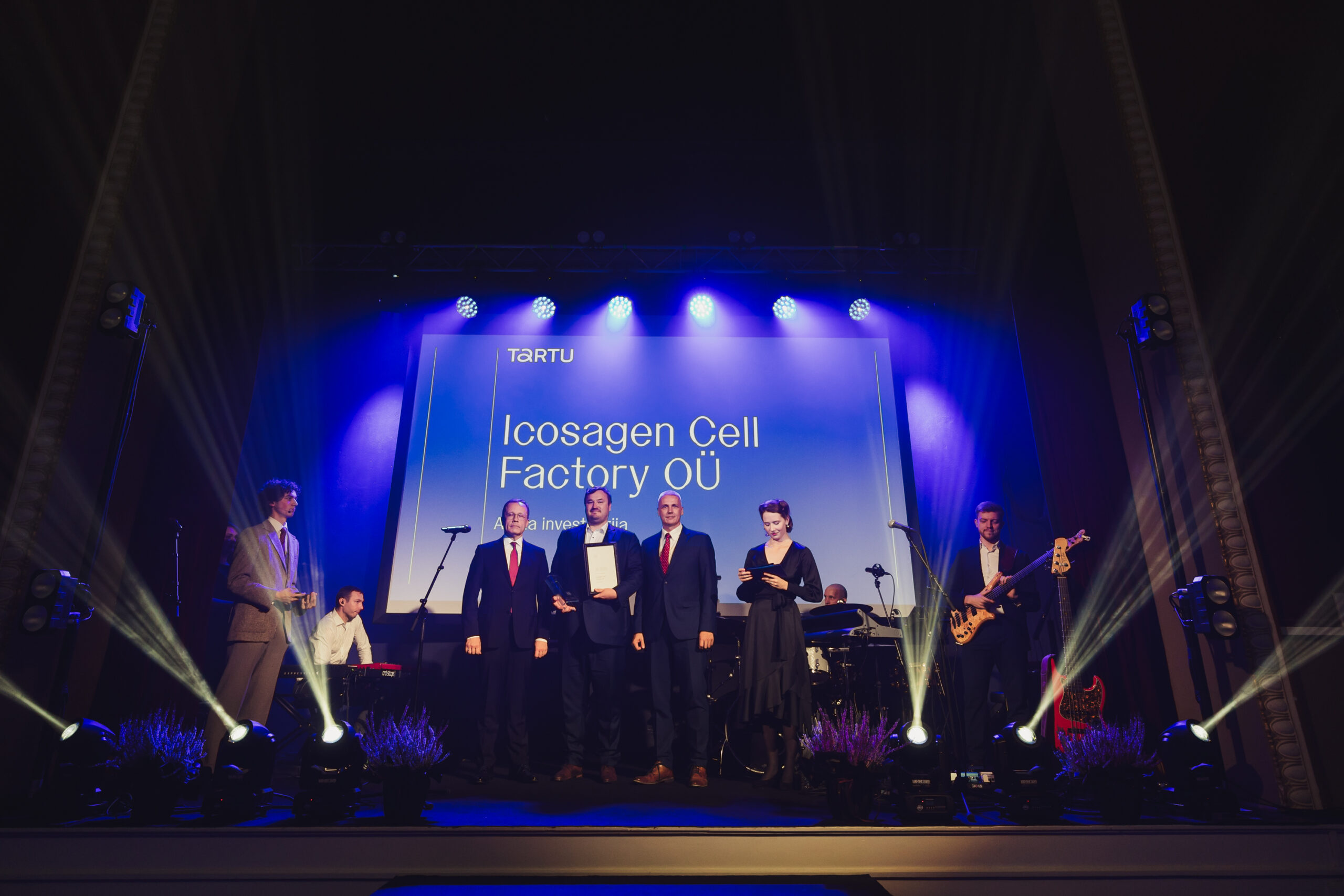
Icosagen Cell Factory OÜ opened a 1,600 square meter manufacturing facility in June 2023, where therapeutic antibodies and proteins for clinical trials are produced. The company was awarded the title of Investor of the Year. Over the past year, Digiwise has had several meetings with Icosagen to support their efforts in taking production process digitalization to the next level.

Icosagen Cell Factory OÜ Foto: Silver Gutmann


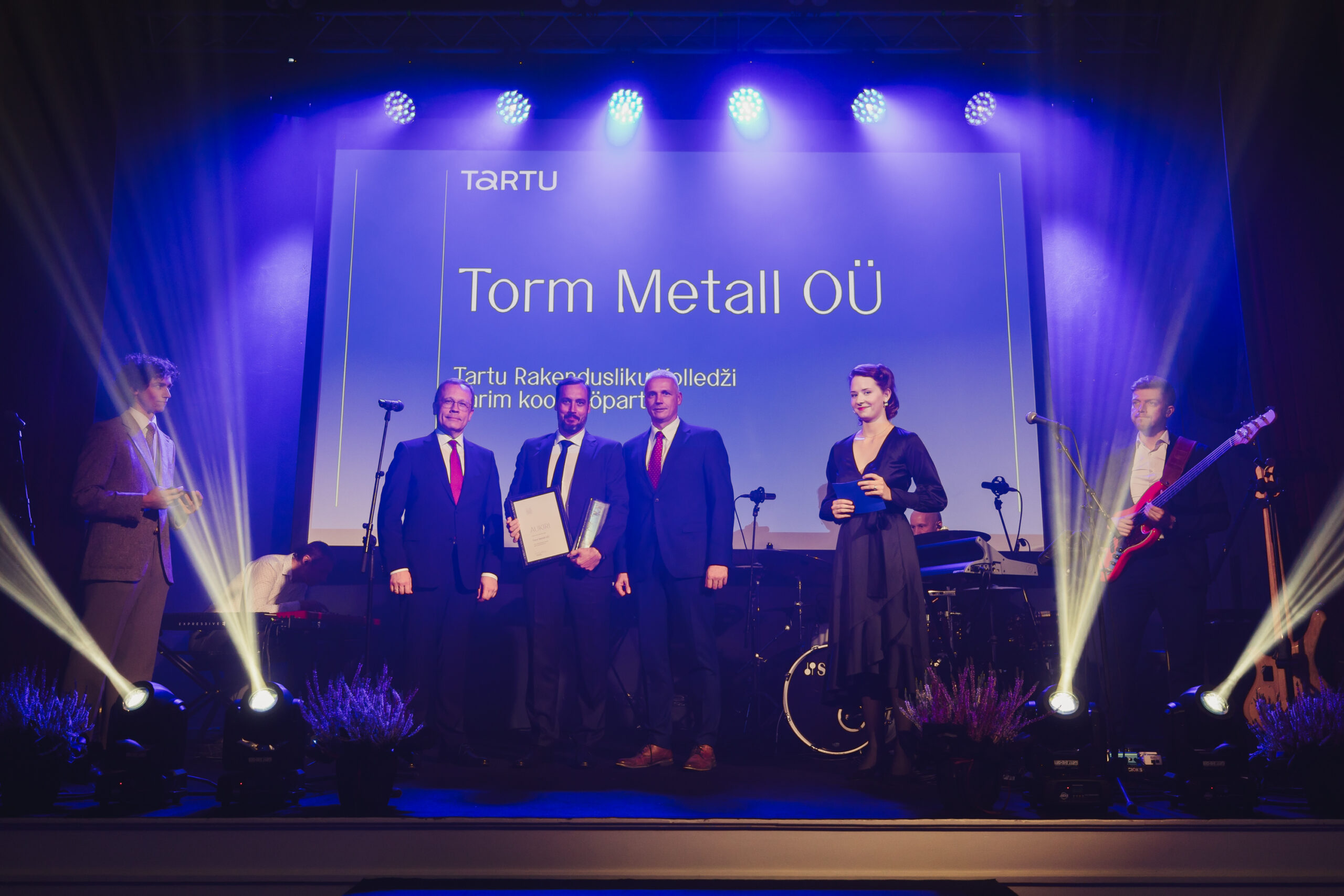
Torm Metall OÜ is a long-time partner of the Tartu College of Applied Sciences. They were recognized for their contribution to advancing applied education, including investments in learning materials, equipment, and mentoring.

Torm Metall Foto: Silver Gutmann


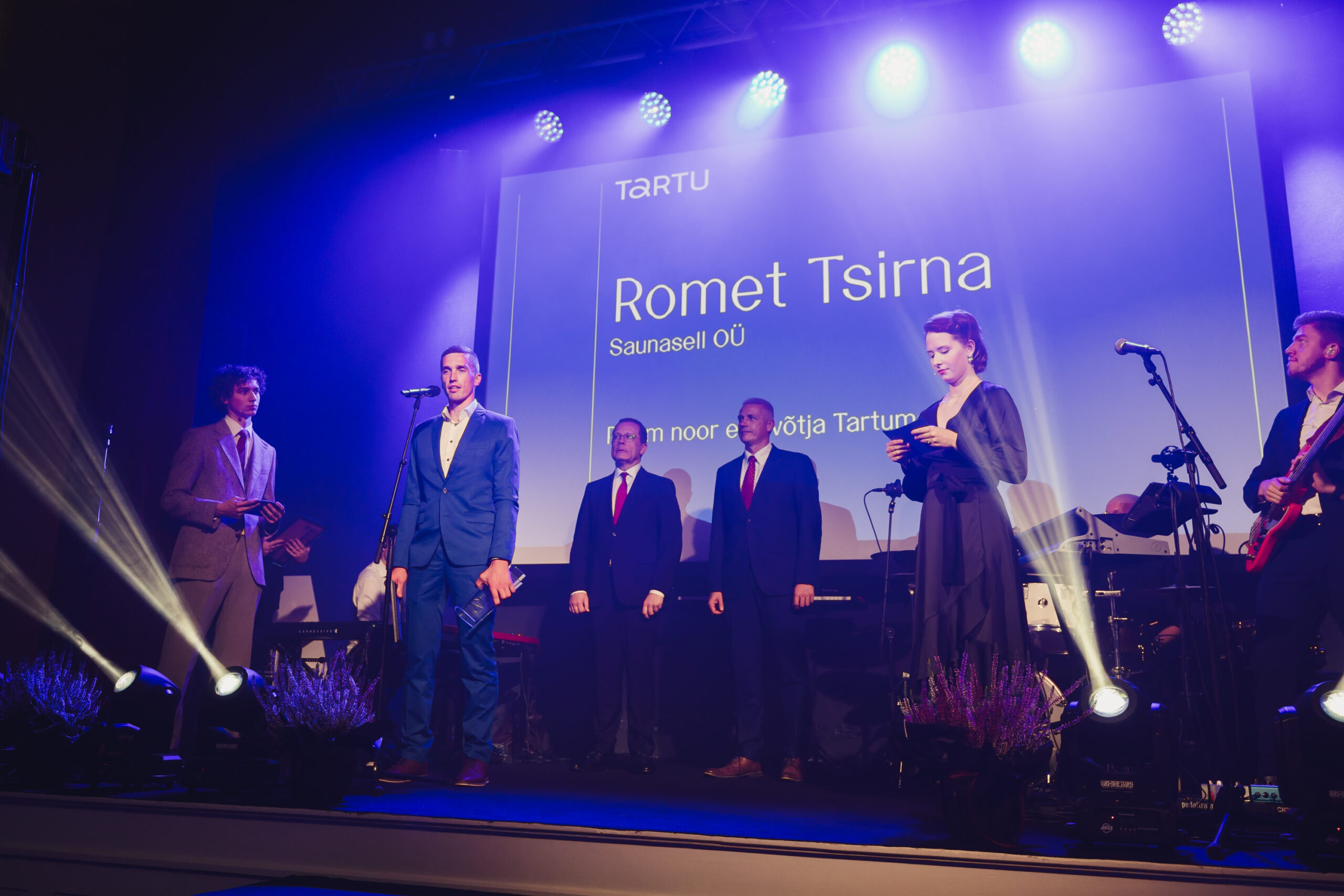
Saunasell OÜ takes pride in Romet Tsirna, who stood out to the Estonian Chamber of Commerce and Industry for his youth and entrepreneurial spirit. Romet was awarded the title of Best Young Entrepreneur in Tartu County. Saunasell OÜ has also shown interest in using artificial intelligence for some of their business operations, and Digiwise has worked with them to explore the best solutions.

Romet Tsirna Foto: Silver Gutmann


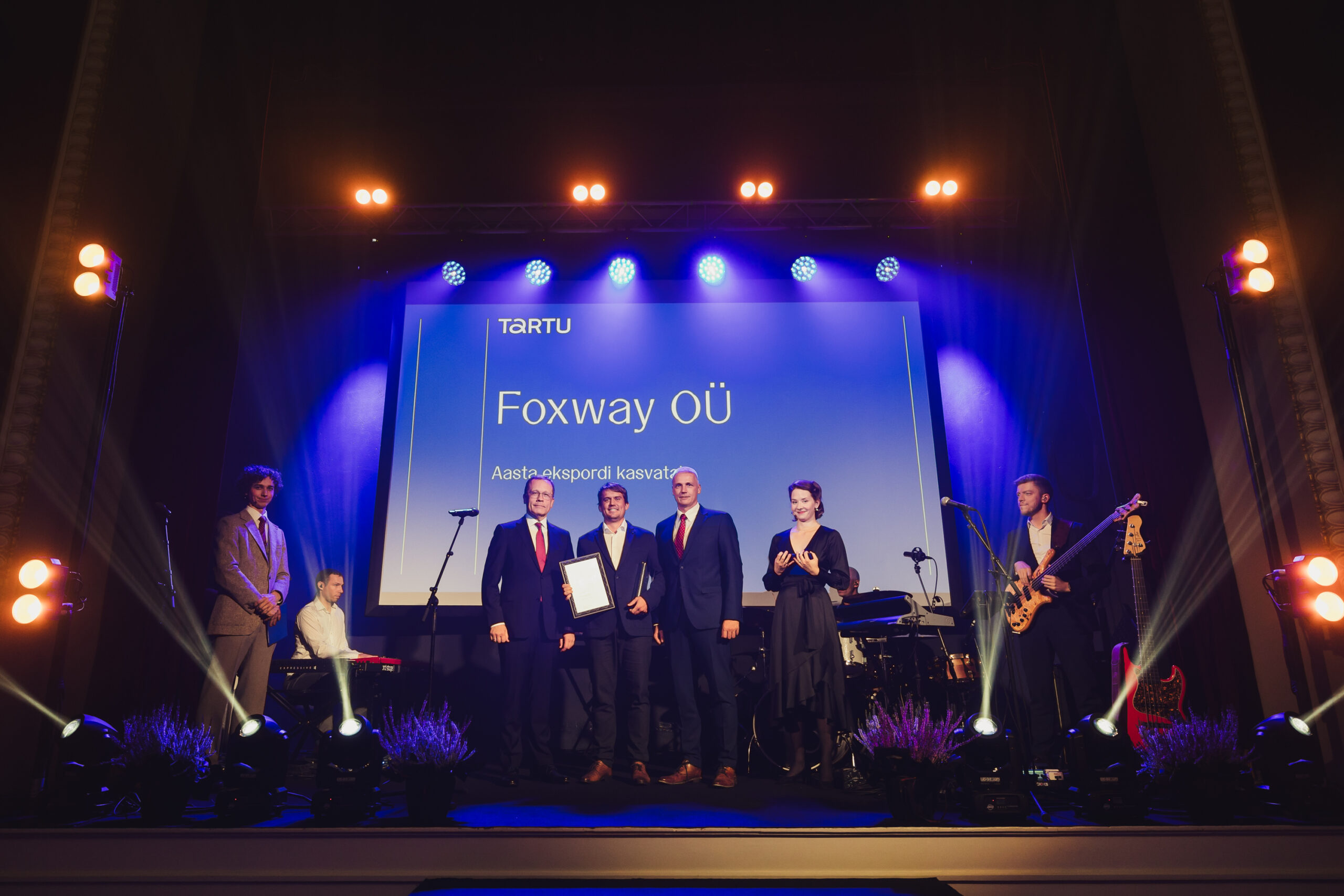
Foxway OÜ received the title of Job Creator of the Year and was also recognized as Export Growth Leader of the Year. Digiwise and Foxway have collaborated through the Digitalization Masterclass, and we are thrilled to see these well-deserved awards go to them.

Foxway OÜ Foto: Silver Gutmann


The recognition of Tartu’s entrepreneurial leaders underscores that innovation and collaboration are cornerstones of successful business ventures. Digiwise is proud to be part of their success story, helping them achieve their goals through the digitalization and automation of their production processes.

Foto: Silver Gutmann

AI Enthusiasts Gather in Tallinn: 10 Practical Lessons on Applying Artificial Intelligence

Author: Elo Gaver

New Nordics AI Week (September 2–6, 2024) brought together AI fans and experts from across the Baltics and the Nordics. The event aimed to share practical ideas, build valuable connections, and support the growth of AI in the region.

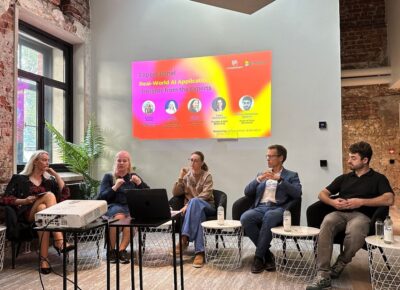
One highlight of the week was the AIPowerment AI Meetup, held on September 3 at Bondora’s office in Tallinn. The event focused on real-life uses of AI in different fields. Around 100 people took part.

The panel included four experts who shared their hands-on experiences:

  • Gerlyn Tiigemäe (Eesti Energia)

  • Sandra Roosna (Askly)

  • Lauri Antalainen (DigiWise)

  • Rafael Gonzalez Iglesias (Bondora)

Here are 10 key lessons from the discussion:

  1. Start with standardisation: To benefit from AI, processes must first be standardised and digitalised. That creates quality data AI can work with.

  2. Find your AI champion: Every company needs a passionate leader to drive AI projects forward.

  3. Check your readiness: Make sure your data is good, roles are clear, and security is in place before launching AI projects.

  4. Respect data rules: Using customer data in AI models means following GDPR and getting consent.

  5. Stay ahead of rivals: Tracking and learning from competitors’ AI tools can give your business an edge.

  6. Use AI to save time: For example, Äripäev uses AI to process podcasts and videos, giving journalists more time to create content.

  7. Leadership support matters: Without backing from top management, AI projects can fail to take off.

  8. Talent is limited: Estonia has few machine learning experts. Companies like Bolt have had to hire internationally.

  9. Focus on efficiency: Right now, AI brings the most value by cutting costs and saving time.

  10. Change your mindset: AI can take over routine tasks, so people can focus on creative and strategic work.

Events like New Nordics AI Week help more people understand what AI can do. They also support Estonia’s role as a leader in digital innovation.

A Successful Finish to the Digitalisation Masterclass

Author: Elo Gaver

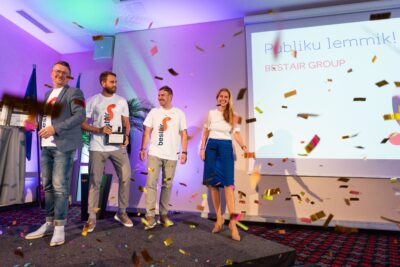
Spring marked the graduation of the seventh group from the Digitalisation Masterclass. This season was especially successful for Digiwise mentors — Malmerk Klaasium, led by Lauri Antalainen, took home the overall win, while Bestair Group, mentored by Olga Luštšik, was voted the audience favorite!

Malmerk Klaasium was proud to receive the top award, especially among a group of 20 forward-thinking companies. According to their team, external feedback and guidance from Digiwise founder Lauri Antalainen gave them the confidence that they are on the right path and ready to take their next digital steps.

Bestair Group also had reason to celebrate, winning the audience favorite award. Their professionalism, initiative, and innovative mindset clearly won people over — qualities that also define them, according to Digiwise Senior Consultant Olga Luštšik.

We’re especially glad to see that both teams developed a strong synergy with their mentors. That kind of connection makes future collaboration much easier, should they choose to continue working together.

Digiwise congratulates both companies and looks forward to cheering them on as they continue their digital journey!

Photos by Tõnis Tõnström.

How AI Impacts Work and Everyday Life – A Conversation on the AIPowerment Podcast

Author: Elo Gaver

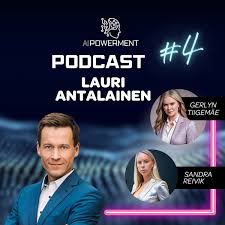
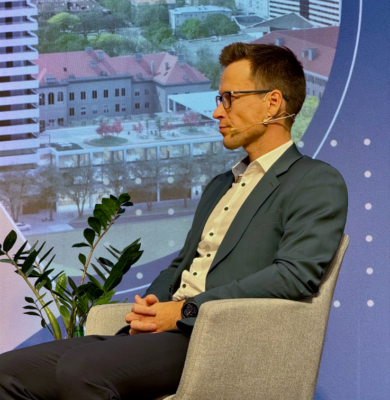
AIPowerment is a podcast that brings listeners the latest news from the world of artificial intelligence, reviews of popular and new tools, and interviews with AI advocates. In a recent episode, the guest was Lauri Antalainen, founder of Digiwise, who shared how AI can benefit people in both their work and personal lives.
For years, Digiwise consultants have helped companies make better use of their data. In the past, this mostly meant analysing internal datasets, since public databases often lacked business-specific value. Having access to large amounts of company data was essential.

But things have changed. The rise of generative AI has made it possible to get value from smaller datasets, too. Thanks to large language models and machine learning tools, even companies with limited data can now use AI effectively.

The conversation also covered the automation of business processes. Digiwise works with companies that have reached the point where process optimisation and automation are no longer optional — they’re essential.

The optimisation journey follows three key steps:

  1. Standardisation – defining the most efficient way to perform a task.

  2. Digitalisation – choosing digital tools to support that process.

  3. Automation – using software and AI tools to automate tasks that were previously done manually.
    AI plays the biggest role in this final step, where its full potential can be realised.

AI isn’t just for work — it can help in everyday life too. Need to compare cars before buying one? AI can build a comparison table in seconds. Planning a party? Let AI suggest creative ideas while you focus on the fun part — deciding between a red or blue car and picking the best theme for your guests.

You can listen to this smart and practical episode now on Spotify (in Estonian) here.

Digital Mentoring for Tourism Businesses – Now with a Digital Roadmap

Author: Elo Gaver

The importance of digitalisation for running a business efficiently cannot be overstated.

Even small businesses eventually reach a point where a shared Excel file just isn’t enough. For years, companies have had the chance to join the Digitalisation Masterclass — a three-month programme designed to help businesses create a digitalisation plan and take their first steps with the help of an experienced mentor. Organisations have also been able to reach out independently to find a suitable business advisor.

Now, tourism companies can benefit from a new digital mentoring service that lasts up to five months. This allows businesses to continue their daily operations while also having access to a mentor whenever challenges arise or new goals need to be set.

One key outcome of this mentoring process is the creation of a digitalisation roadmap — a vital document for applying for the EAS digital transformation support scheme.

You can find more details about this new service on the Visit Estonia website.

How AI Is Changing the Business World Around Us

Author: Elo Gaver

At the 2024 TalTech Business Forum, Lauri Antalainen gave a talk called “How Artificial Intelligence Is Changing the Business World Around Us.”

The talk was full of practical examples. Lauri shared tips on how to choose your field of study and focus your learning. He also explained how to divide work between people and AI in a business.
His main message was simple: AI is here to stay. The sooner we learn to work with it, the better our chances of success.

After the talk, students had the chance to ask questions. Their worries were addressed — both from those afraid AI might replace their jobs and those concerned about AI doing the thinking for us.

It’s a great one-hour listen, available now (in Estonian) on YouTube.

Two Things to Do Before Using AI in Industry

Author: Elo Gaver

Äripäev Radio recently invited Lauri Antalainen, Lead Consultant at Digiwise, and Kristiina Niilits from the joint organisation of EAS and KredEx, to discuss how artificial intelligence is being used in the industrial sector.

In the episode, Digiwise shared many practical examples of how AI is applied in real industrial settings. Kristiina Niilits introduced a range of government support measures available to companies for factory development and innovation.

Curious to know where to start?
There are two key steps every company should take before implementing AI in their production processes.

🎧 Listen to the full episode (in Estonian) to find out what they are!

AI in Business: Upcoming Events and Opportunities

Author: Elo Gaver

Not long ago, artificial intelligence felt as distant and futuristic as flying cars. But today, one thing is clear — AI is here to stay.

Several exciting events are coming up that will explore how businesses can use AI to improve and innovate.

TalTech Business Forum 2024March 27–28, Tallinn
Estonia’s largest youth entrepreneurship conference will host a range of inspiring speakers. Among them is Lauri Antalainen, who will discuss how AI is reshaping the business landscape.

MELT Innovation ForumApril 16, Tallinn
This year’s theme is “Artificial Intelligence – A Creator of a Better Future?”
The opening panel will dig into this big question. Speakers include Lauri Antalainen, Agnes Roos, and Otto Mättas.

Narva-Jõesuu Business Conference 2024May 9, Noorus SPA Hotel
Boldly titled “The Future Is Here!”, this conference brings together local entrepreneurs, municipal leaders, and decision-makers. Lauri Antalainen will again be sharing insights on the practical use of AI in business.

At Digiwise, we’re proud to see so many forward-thinking Estonian businesses embracing the possibilities of AI. These conversations are shaping a smarter and more innovative future — and we’re excited to be part of it.

See you at the conferences!

Digiwise Helps You Apply for Business Support Funding

Author: Tomi Meitus

For years, Digiwise has supported companies in finding the right funding measures and preparing strong project applications. Once again, it’s a great time to apply for funding to boost your business growth and investments!

The Estonian Business and Innovation Agency (EAS) has opened applications for the Business Development Programme, offering up to €500,000 in support for ambitious growth plans.

Additionally, large manufacturing companies can apply for the Major Investor Grant, which includes support for new building construction — from €1 to €3 million in funding.

Current and upcoming support schemes are open to both SMEs and large companies. Funding can be requested for:

  • business digitalisation,

  • purchasing equipment for manufacturing,

  • implementing automation solutions,

  • and many other development activities.

To learn more about the available opportunities through EAS and the Environmental Investment Centre, get in touch with us. We’ll help you find the best match for your business goals and guide you through the application process.

Book a free online consultation with one of our advisors today!

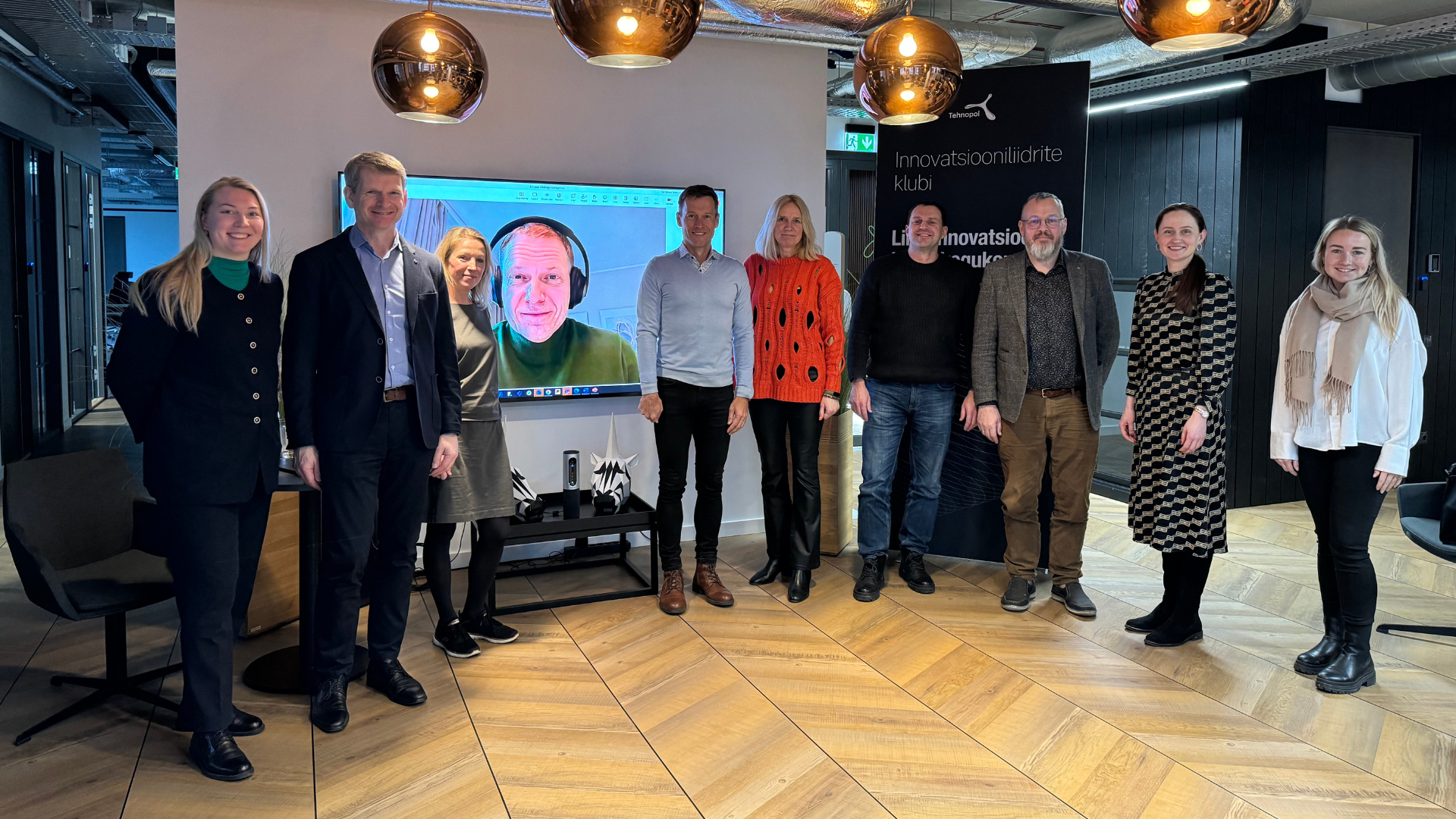
Innovation Leaders Club Has a New Advisory Board

Author: Elo Gaver

The business world is always changing. To keep up, companies need more than just good products — they also need strong innovation skills.

To support this, Tehnopol and SEB launched the Innovation Leaders Club in June 2020. The club helps Estonian companies work together on innovation.

Digiwise has been part of the club for some time. In February 2024, the club elected a new seven-member advisory board. One of the new members is Lauri Antalainen, Lead Consultant at Digiwise. The board will set new goals, grow international cooperation, and help measure the impact of the club’s work.

The board’s main focus for this year is the Innotrepp online platform. This new digital tool supports collaboration and helps Estonian companies build a stronger innovation culture.

The Innovation Leaders Club is always open to visionary thinkers and ambitious businesses from all sectors who want to explore new ideas.

Practical Experience: Automating Contracts – A Costume Rental Case Study

Autor: Olga Luštšik

Many businesses face challenges when it comes to creating contracts — whether they’re service agreements or employment contracts. Collecting data through email and copying it manually into Word documents takes time and often leads to errors.

In this case study, we show how a fictional Costume Rental business can digitalise its order intake and contract process. By using simple and accessible tools, businesses can save time and provide clients with faster, more convenient service.

In the video series, we introduce these low-code/no-code tools:

  • Creating a website with Durable

  • Explore the fictional Costume Rental site here

  • Building intake forms with Google Forms

  • Creating contract templates with Google Docs

  • Storing submitted data using Google Sheets

Watch how these tools can breathe new life into everyday business processes.


This article is part of our Practical Experience series, which highlights the benefits of using Low-Code/No-Code (LCNC) software for business process digitalisation.
You don’t need to be a programmer — with the right tools, digital solutions are now within reach for everyone!

Practical Experience: A DIY HR Management App – A Café Case Study

Author: Olga Luštšik

In many companies, support processes often take a back seat to more urgent core activities. One commonly overlooked area is HR management. Employee data — contracts, files, training certificates, forms, and personal notes — may be scattered across spreadsheets. This can lead to confusion, limited visibility, and difficulties in managing tasks like vacation requests or gathering statistics.

Onboarding new employees can also become inefficient when IT setup and preparations are left to the last minute.

HR software might seem like the obvious solution — but many systems are expensive or too complex. That’s why we decided to build a custom, cost-effective solution ourselves.
In this case study, we demonstrate how a fictional Café business can successfully digitalise its recruitment and HR processes. The result? Huge time savings for internal teams and a smoother experience for employees.
We introduce the following low-code/no-code tools in the video series:

  1. Creating a website using Durable
  2. Explore the fictional Café’s website here
  3. Using Airtable
  4. Setting up contract templates in Google Docs
  5. Storing employee info in Google Sheets
  6. Take a look at the fictional HR management app here


🎥 Watch the video series (in Estonian) for hands-on inspiration:


This article is part of our Practical Experience series, which explores the power of Low-Code/No-Code (LCNC) tools in business process digitalisation.
You don’t always need a developer — with the right tools, digital solutions are now within everyone’s reach!

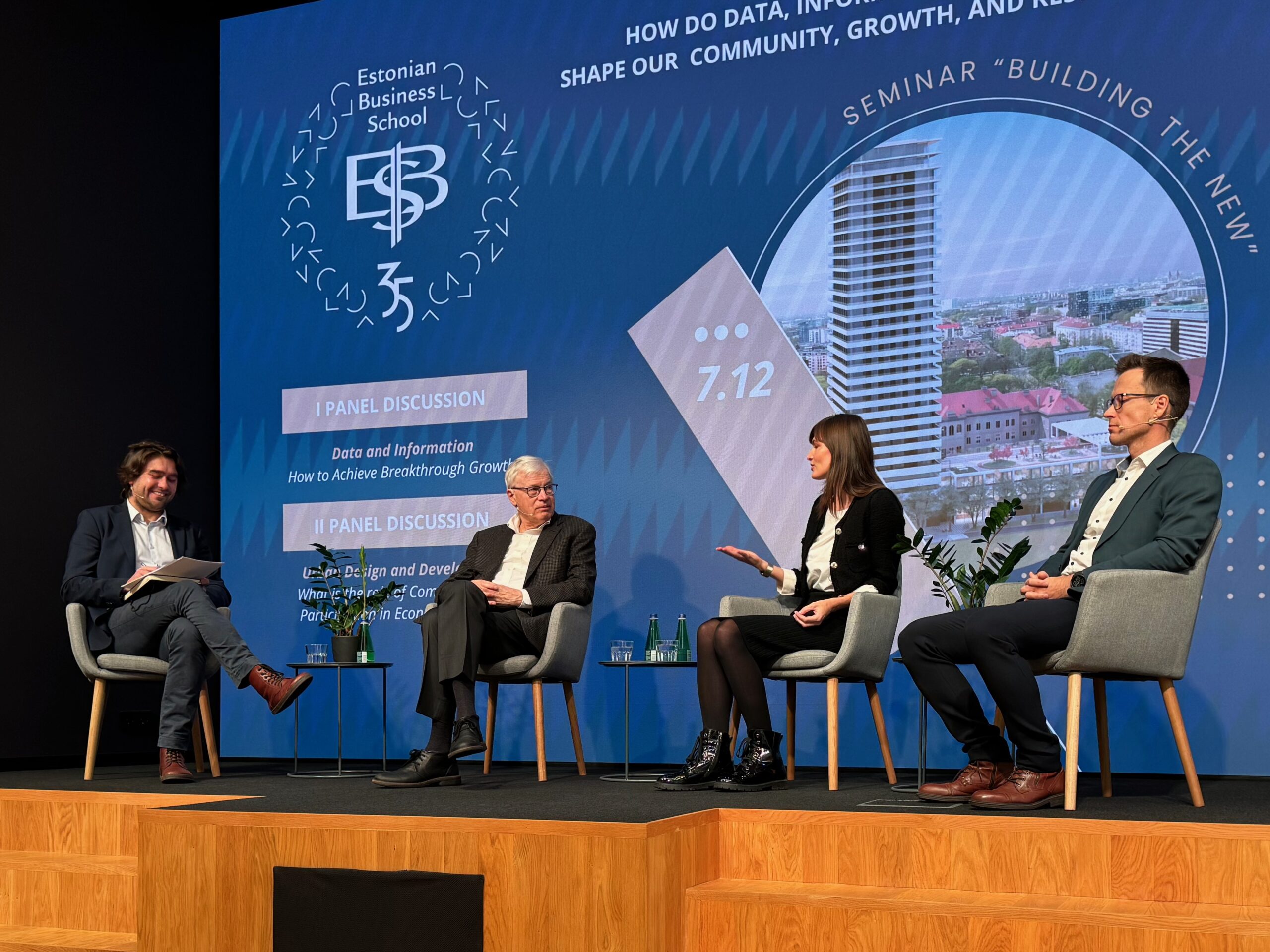
EBS Anniversary Panel: “Data and Information – How to Achieve Breakthrough Growth?”

Author: Elo Gaver

To celebrate its 35th anniversary, Estonian Business School (EBS) hosted a conference titled “Building The New: How Data, Information and Urban Design Shape Our Community, Growth and Responsibility?”

The first panel discussion — “Data and Information – How to Achieve Breakthrough Growth?” — brought together a powerful mix of voices:

  • Bengt Holmström, MIT economics professor and Nobel laureate

  • Kadri Tuisk, EBS alumna, founder of SageOS and Clanbeat, named Young Female Entrepreneur of the Year in 2021

  • Lauri Antalainen, founder of Digiwise and President of EstBAN
    The discussion was moderated by Andreas Veispak.

All panelists agreed: AI is evolving fast, and we’re witnessing a shift in mindset. As Lauri noted, many once thought of AI like flying cars — futuristic and out of reach. But since ChatGPT, that perception has changed. Now, even CEOs are asking, half-jokingly, “Which employees do we really need to keep?” Used wisely, AI is a powerful tool that’s breaking through old limitations.

Kadri Tuisk called it an exciting time to grow alongside AI, especially in startup culture. With today’s tools, a 48-hour hackathon can achieve far more than ever before.

Lauri shared real-world client stories on digitalisation and automation, highlighting how AI is no longer abstract — it’s reshaping everyday work.

And Bengt Holmström made a memorable call to action:
“Forget physical training — focus on improving your ChatGPT skills!”

🎧 The full recording of this English-language panel is available here.

The Final Edition of the Digitalisation Masterclass Begins!

Author: Elo Gaver

Digitalisation is like a living organism — it’s always present in a company and always needed. That’s why it’s important to break it down into clear projects, write out the steps, and make sure someone is guiding the process. Only then can digital tools support the business in the right way.

The spring edition of the Digitalisation Masterclass was introduced in a one-hour webinar by mentors Roman Zahharov, Lauri Antalainen, and Juhan Pukk. They talked about how to find the right digital solutions, automate business processes, and collect useful data.

The key message: a digital project has three equal sides — the client, the supplier, and the system itself. If any one of them fails to engage, the whole project can fail. In fact, 75% of new business solutions don’t succeed. Not because the tools are bad, but because they don’t fit the company’s needs.

The webinar also offered simple steps that any company can take before calling in experts. For example:

  • Use one main communication tool
  • Organise conversations by topic, not person
  • Use clear file naming rules
  • Create checklists for key processes

What about data? What’s worth collecting? The speakers shared real-life stories — like losing extra sales due to missing info, or having to search online for invoice details. In some cases, even logistics teams had to call clients to ask where and when to deliver.

All of these topics — and more — are covered during the Masterclass. Every participating company works with a mentor who helps find the “bottleneck” — the place where digitalisation can make the biggest difference.

Digiwise is proud to contribute three mentors to the programme: Lauri Antalainen, Olga Luštšik, and Ingrid Prinsthal.

👉 Registration for the spring Digitalisation Masterclass ends on February 7, 2024.

Supreme Court Special Recognition for Case Competition Participant

Author: Elo Gaver

For the second year in a row, Geia Rõivas, a student at Miina Härma Gymnasium, took part in the Supreme Court of Estonia’s student case competition — and received a special mention for her outstanding work.

This time, the jury praised her original thinking and independent approach to solving the case. Geia was mentored by Elo Gaver, Assistant to the CEO at Digiwise, who also teaches full-time in the classroom.

The Supreme Court’s annual competition invites students to step into the shoes of a judge. Participants are given real-life inspired cases and can choose to solve them in the fields of administrative, criminal, or civil law. They can submit either a written judgment or a creative-format response.

Geia chose to solve a civil law case and submitted a traditional written judgment. Over 70 students submitted entries, and just over 40 made it to the jury’s desk. The jury praised the maturity of the students’ reasoning and noted that while most entries refer to the Estonian Constitution, many also rely on specific laws and regulations.

The mentor’s role is a delicate one — to guide, offer feedback, and help the student stay focused, without ever taking over the process. The student’s own values and sense of justice must shine through.

For a mentor, seeing a student grow and explore new opportunities is its own reward. Thanks to last year’s recognition, Geia has already taken part in job shadowing experiences at both the Ministry of Justice and the Harju County Court.

First Creative Companies Graduate from the Real-Time Economy and Digitalisation Masterclass

Author: Elo Gaver

In October, the first group of creative companies joined the Real-Time Economy and Digitalisation Masterclass — a new course designed especially for businesses in the creative sector.

Digiwise helped develop the programme to improve business processes using innovative digital tools and real-time economy solutions.

Now, after 2.5 months of learning and collaboration, the pilot group has completed the course. Every company found new ways to tackle their business challenges through smart and practical digital solutions.

Digiwise sends a big congratulations to all graduates — and wishes them a journey that’s faster, higher, and farther.
We look forward to welcoming the next group this spring!

The Artificial Intelligence and Robotics Center AIRE offers advisory services on the feasibility of implementing artificial intelligence in industrial enterprises.

Author: Elo Gaver

Tehnopol Science and Business Park conducted a public procurement process to find partners who could provide advisory services on the feasibility of implementing artificial intelligence in industrial enterprises. The new partners selected include Proud Engineers OÜ, Lean OÜ, Net Group OÜ and Digiwise OÜ, who are all experts with extensive experience in advising on the feasibility of implementing artificial intelligence. Digiwise has already offered guidance on this topic to more than ten companies, some of which have also received support from the Ministry of Economic Affairs and Communications for their pilot projects.

The advisory service is mainly intended for small and medium-sized Estonian manufacturing companies that wish to increase productivity by incorporating artificial intelligence competencies into various production processes. The advisory service involves preparing a report for the company, mapping out their strengths and weaknesses, and their capability to implement artificial intelligence.

The report provides a clear overview of the feasibility and practicality of implementing artificial intelligence solutions and, based on the results obtained, companies have the opportunity to seek additional funding from both AIRE’s advisory services and Tehnopol.

The contract for providing advisory services is valid until 2025, and companies can register for the advisory service here.

Estiko-Plastar can invest in a better future by implementing green technologies.

Author: Elo Gaver

Estiko-Plastar AS approached Digiwise with an ambitious desire to modernise production and bring a new sustainable and innovative product category to the market. Our part in this process was to help Estiko-Plastar think through the project plan and the financial calculations related to the new product as well as to find additional financing for investments.

Estiko-Plastar’s daily commitment to constantly move towards more environmentally friendly solutions, their strategic choices, post-processing, and extrusion have been a direct indicator for other production companies as well as customers. Therefore, we wanted to contribute to taking the next steps and helped to find additional funding for the implementation of the project.

The goal of the Estonian-Norwegian cooperation programme is to support the sustainable development of companies, and we helped Estiko-Plastar prepare a project. It received a very high score from the project committee and received funding, too. During the project, a new printing machine, an additional plastic regranulation device to increase recycling, and a laser cleaning device for the environmentally friendly cleaning of aniloxes used in printing machines were placed in the production building. The existing afterburner will also be expanded as part of the project, and additional developments will be carried out for resource planning software. To make all this possible, the production building was expanded. Many new jobs are planned to be created through the project. Given the challenging times in the industry, this is undoubtedly welcome news.

The Digiwise team is happy that the project prepared with our help was successfully launched. In the meantime, we have also carried out the next cooperation project with Estiko-Plastar in assessing the company’s readiness for artificial intelligence.

How to avoid costly mistakes? – Smart Manufacturing Meetup

Author: Elo Gaver

The Smart Manufacturing Meetup took place in Tartu for the fifth time, where it focused on the benefits of digitisation. The goal of the conference has always been to offer participants new ideas and solutions in a pleasant setting. This event, too, offered something for the live audience, those participating via video link and the contributors who shared their ideas on stage.

Lauri Antalainen, Chief Consultant at Digiwise, led a discussion on how to avoid mistakes related to digitisation.

In consulting work, we come across mistakes that have previously been made involving a specialist. Panelists Reigo Rusin, Kadri Rehkli and Kaur Saarepuu agreed that digitisation doesn’t necessarily make processes easier simply for the sake of digitisation. Just because one company uses ERP doesn’t mean it is the answer to all the questions of another company.

Lauri Antalainen pointed out that the most important stages of the four-stage journey of digitisation are the first and the fourth.

It is important to start with mapping out the problems. His idea was further developed by Kadri Rehkli, who talked about practical experiences and shared a story about how they thought they desperately needed an ERP system without knowing what possibilities it offered and which problems it solved.

Once the problems have been identified, work can begin towards solving them – at this stage, the insight of an experienced consultant who has encountered countless similar challenges over the years and is familiar with various solutions can be extremely useful.

When suitable solutions for the company have been identified, they need to be implemented. This is the stage that some mistakenly believe is the end of setting up the digitisation process. However, Reigo Rusing aptly said that no matter how good the coach is, you still have to run the race yourself. In other words, the last stage, implementation of the solutions, is something that all employees in the company must be involved in, and if not addressed properly, all the previous work will have been in vain.

Therefore, it is important to ensure from the outset that the company is clear about which processes need to be digitised, and that the entire team is willing to work on implementing the new solutions.

EIT Digital opens its Baltic office in Tallinn.

Author: Elo Gaver

Europe’s most influential digital development and innovation cluster, EIT Digital, opened its Baltic office in collaboration with the Estonian Research Council and TalTech Mektory. The purpose of establishing the office is to increase investments in research and development activities, as well as to promote the more effective integration of regional digital innovation and entrepreneurship communities.

The opening of the office was marked by a conference led by Johannes Tralla, who engaged in conversations with guests throughout the day. Among the speakers was Lauri Antalainen, Chief Consultant at Digiwise, who discussed topics related to the importance of digitisation – this is clearly a growing trend, but how can we ensure that it actually brings benefits?

EIT Digital offers various opportunities for universities as well as businesses. Its support is important for fortifying the innovation ecosystem and fostering relationships with different European stakeholders. Furthermore, it offers new prospects for our own start-ups.

Digiwise attended a development marathon organised by Tehnopol and evaluated the business and technical aspects of ideas.

Author: Elo Gaver

Tehnopol Science and Business Park hosts AI development program hackathons for companies whose processes in manufacturing, customer management, product development or other areas could be made more efficient and sustainable with AI solutions.

The hackathon held in August welcomed data-intensive education, green, health and industrial companies. During the hackathon, solutions were found for creating a new technical AI solution, evaluating the new solution from the commercial side and creating a comprehensive project plan. The main focus of the event is teamwork in creating AI solutions.

In addition to companies interested in improving their processes with AI, the hackathon welcomes anyone who can and wants to test themselves in creating and implementing AI solutions. The program also features experienced trainers and mentors, who help to match problems with solutions.

Digiwise participated in the program as an evaluator of AI solutions from the technical and business side. We wish all funded teams the best of luck! You can read more about their ideas on the Tehnopol website.

Digiwise has assessed and consulted Estonian industrial enterprises on implementing artificial intelligence.

Author: Elo Gaver

Since its inception, Digiwise has researched and analyzed fourteen forward-thinking Estonian industrial companies to determine their readiness to implement artificial intelligence. Among others, we have been approached by companies from the forest, metal, plastic, food, oil and textile industries seeking our advice.

Innovation-minded companies seek to digitize their processes. They understand that it is wise to consult specialists for answers to existing questions and to those that arise during the process.

Questions typically arise around the following topics:

  • Requirement prediction – statically set requirements for inventory and other parameters in production programs are insufficient. Instead, smarter solutions are needed that dynamically predict both the requirements and other parameters and adjust them as circumstances change.
  • Predictive maintenance – enterprises seek solutions that can predict equipment maintenance needs, and thereby save time and resources. This, in turn, would reduce the likelihood of more costly problems arising.
  • Automation of robotic processes – most companies see potential in this area, but questions arise about the rigidity and capabilities of the software.
  • Automated guided vehicles (AGVs) – there is a growing interest and need for them. The movement of material from storage to production, as well as transferring components and semi-finished products between workstations is a time-consuming process that can now be automated through the use of robots.
  • Quality control – several timber industry companies already use artificial intelligence-based solutions for sorting and assessing timber quality. Other companies are also assessing the opportunity for and exploring the means to digitize quality control.

Companies that have sought advice from us include Tarmeko Spoon AS, Lasita Maja OÜ, Nõo Lihatööstus OÜ and Baltoil AS.

The framework for implementing artificial intelligence in industrial companies is now available.

Author: Elo Gaver

AI and Robotics Center AIRE collaborated with Digiwise to develop a framework for implementing artificial intelligence in Estonian industrial companies. The framework was needed in order to define projects that AIRE can assist businesses with and to create a vision and decision-making document for industrial companies to plan their AI and digital development.

The framework has already been used by AIRE, the Ministry of Economic Affairs and Communications and several consulting firms offering AI advisory services.

AIRE is dedicated to promoting the development and innovation of Estonian industry, and Digiwise is delighted to support this initiative.

Digiwise leads the conversation on the use of artificial intelligence in industry.

Author: Elo Gaver

On 13 April 2022, “Artificial Intelligence in Industry and Support Measures”, the fifth event of the AI & Robotics Estonia club, took place in the Yanu OÜ premises in Tartu. Digiwise was there to lead the discussion on the use of artificial intelligence in industry. The participants who shared their thoughts included Karl Kruusamäe from University of Tartu, Oskar Kilk from TORM Metall OÜ, Marko Saviauk from Leanest OÜ and Alan Adojaan from Yanu OÜ. The discussion was moderated by Lauri Antalainen.

During the conversation, the participants exchanged experiences on the topic of prejudices related to robots. It has often been necessary to convince companies that robots can be trained to do what humans do, and in some respects, robots can be even more efficient in doing the same job. However, the fact that training a robot is a time-consuming process should certainly not be ignored.
Another idea that emerged was that if there is a desire to get something done, a solution can always be found. A good example of this was the Yanu OÜ robot bar – after experiencing bottlenecks in how bars function, the founders came up with an idea to solve them, and the result is a fully self-functioning contactless robot bar.

As the event took place in Tartu, Katrin Kask, head of the Department of Business Development at Tartu City Government, presented support measures for the financing of production and digitisation for companies based in Tartu.

Kersti Kuusalu spoke about the digitisation journey among Estonian companies, and Kirke Maar introduced the future of AIRE and financial advisory services.

The highlight of the evening was testing the robot bar, which was accompanied by great food and pleasant company.

ELMO Rent received a large grant from Enterprise Estonia.

Author: Elo Gaver

ELMO Rent has been developing its remote-controlled car and controller technology for over a year. While currently the rental car is delivered to the customer by an ELMO driver, then after the introduction of remote-control technology, the car will reach the customer by remote control. Therefore, the introduction of new technology reduces the cost of delivering a car to the customer and increases the efficiency of car use.

ELMO Rent is satisfied with the opportunities offered in Estonia for the implementation of various innovations. “Estonia is the only right place for developing and testing innovation, and if we can speed up the global conquest of green technology in cooperation with the state, then everyone will win,” said Enn Laansoo Jr., founder of ELMO Rent. “The purpose of Enterprise Estonia is to support ambitious companies such as ELMO Rent in challenges related to export and product development so that their developmental leap is as big as possible,” said Peeter Raudsepp, Head of Enterprise Estonia. So, Enterprise Estonia simply needed someone to formalise the reception of support successfully.


Digiwise consultant Tomi Meitus accepted the challenge and is glad to be able to help ELMO Rent take its development to the next level. As the grant received will help ELMO Rent complete the processes of remote-controlled cars, Tomi hopes to see remote-controlled cars on city streets soon.

Lauri Antalainen was elected as the new VP of EstBAN

Author: Elo Gaver

Estonian Business Angels Network was founded in 2012 as an umbrella organisation for business angels and business angel groups seeking investment opportunities in Estonia to grow the quantity and quality of local seed-stage investments.

On the 31st of August in 2021, due to changes in the EstBAN board, a new President and Vice President were elected. As of that day, Lev Dolgatsjov will serve as the President and Lauri Antalainen as the Vice President. Lauri has already been a board member of EstBAN for a little over two years. He says that business angels in Estonia are having great times and opportunities to fund new ideas right now. During the last year, a record number of new members have joined, so EstBAN already has about 230 bold and innovative investors.

Changes in EstBAN board – EstBAN

Lauri Antalainen Foto: Jake Farra

Five important reasons why you should digitalise the flow of information in production right now

Author: Lauri Antalainen

When implementing production, it is important to consider how work orders are transmitted to production and how the implementation of these work orders is reported. The organisation of production management can be judged by its digitalisation:

  • At one end of the scale, production will be completely paperless, with work orders, their reporting, stocking and other operations fully digitalised and in real time.
  • At the other end of the scale is the type of manufacturing, where work orders, drawings and other information are printed out in the office, taken to the production floor, where these papers then make their ‘rounds’ and come back to the office with notes made by the production worker. In the office, someone collects these papers and enters the information, usually either into an accounting program or Excel.

Non-digital, paper-based production management has a number of other important shortcomings that can be eliminated through digitalisation, in addition to the miles-long daily transportation of documents by workers.

Five important reasons why you should digitalise the flow of information in production right now are:

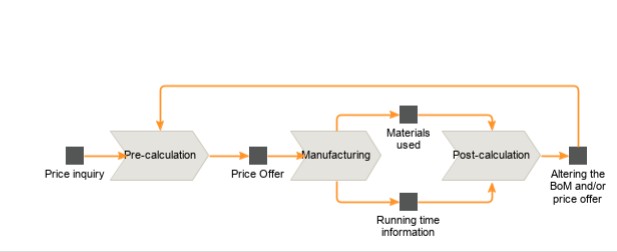
1. Post-calculation and cost price calculation

Post-calculation should be an integral part of the core process of any manufacturing company. Unfortunately, many companies still do not do this (or do it only partially) because they lack the information needed to carry out post-calculation. This, in turn, means that the calculation of cost price of the product and of production itself (cost estimate) on which the quotations are based is often inaccurate and the prices offered to customers are sometimes too high and sometimes too low. Even more problematic is the fact that a company tends to win bids that are too low, more often than average, while it loses work to competitors with bids that have been made too high. The result is lower profitability and lost work.

To perform a post-calculation, the following digital information is needed: the amount of material actually used to manufacture the product and the time spent on operations. The collection of information requires work reporting on a work centre basis and the existence of a system of stock records related to production orders. Only a digitalised process can ensure sufficiently accurate accounting of both material and time consumption.


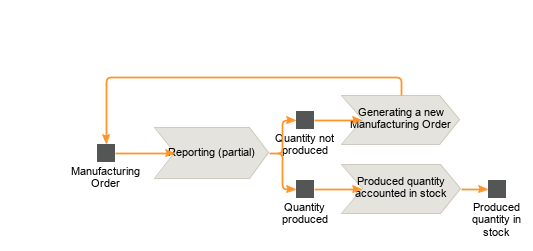
2. Tracking and partial reporting of production orders

A major problem in non-digitised production management is the lack of information in the office about the status of one or another production order currently in production. It is not possible to respond to a customer’s queries about the delivery time of a product without asking for this information on the production floor. Even more problematic is the situation where, for one reason or another, it is not possible to complete a production order, but there is a wish to invoice (and potentially ship to the customer) the items or quantities already produced. Partially reporting the completion of work orders on paper is complex and requires a lot of non-value-added activities both in production and in the office.


In order to digitalise partial reporting of production orders, MRP functionality should be available in the work centre to allow partial reporting of a production order, ideally automatically generating a new work order for the unreported part.


3. Monitoring OEE – Overall Equipment Effectiveness – and occupancy of work centres

The importance of monitoring the occupancy of work centres has been recognised for many years, and a number of production facilities, also otherwise poorly digitalised ones, have introduced external tools to measure and visualise overall equipment effectiveness and cycle times. While useful, there are also problems with using such external tools (especially if they are not linked to the company’s ERP system) – describing the nuances of deviations from the norm/cycle times is often an extra task that production workers do not have the time or the work ethic for, and is often left undone. The result is knowing that overall equipment effectiveness was low, without knowing what caused it and what could be done to prevent it in the future.

Fully digitalised production order transmission and reporting, and the digital, real-time handling of additional information – workers on the shop floor, job types, etc. – will take overall equipment effectiveness monitoring and the related analytics to a qualitatively new level. A decrease in overall equipment effectiveness can be immediately linked to various parameters such as the worker, the type of production order and its parameters, the raw materials used, etc. In addition to the knowledge that the overall equipment effectiveness is at level X, knowledge of the associated circumstances is also added. In well-digitalised production, the company’s own information system is often sufficient to monitor overall equipment effectiveness, and no external tools are needed.


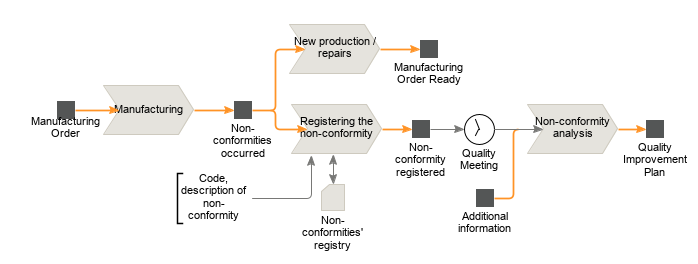
4. Information and analysis of non-conformities

The monitoring of non-conformities (or defects) and the gathering of information on them is already carried out by the vast majority of manufacturing companies operating in Estonia. If what is happening on the production floor has not been digitalised, the typical solution is a sheet of paper with a predefined description of the non-conformity and the likely cause. These sheets of paper are collected, the information on them is entered into Excel, and a meeting is held once a week or month to analyse the information on such non-conformities.

Collecting this kind of information is certainly helpful, but nowhere near as effective as digitally collecting the information on non-conformities in a structured and digitally processable form. While the analysis of non-conformities in Excel usually focuses on the most recent acute cases, structured nonconformity information, linked to predefined defect codes and specific orders, allows one to keep an eye on the ‘bigger picture’ and to see correlations between the occurrence of a non-conformity and the work centre/worker/technology/type of work and other parameters. Only having digital and structural information enables one to take data-driven management decisions to further prevent non-conformities.


5. BI – Business Intelligence

Last but not least, a very important reason to digitalise what happens on the shop floor is the capacity that will be created to implement different types of business intelligence. The management of what is happening on the shop floor, in the form of work order transmission and reporting, generates a wealth of operational information that is of much higher quality (more accurate and comprehensive) than that collected manually and stored in Excel. Operational information gathered in this way on a day-to-day basis can later be used to make or support different types of business decisions, whether related to investment, human resources, production management, etc.


The article originally appeared in two parts in Äripäev’s thematic news site Tööstusuudised:
Info liikumise digitaliseerimise 2 põhjust tootmises: järelkalkulatsioon ja osaline raporteerimine – Tööstusuudised (toostusuudised.ee)

Lauri Antalainen: taktiaegade kõrvalekaldumise asjaolud jäävad tihti kirjeldamata – Tööstusuudised (toostusuudised.ee)

The first class of Digitalisation Masterclass has graduated

18 companies have successfully graduated from the three-month Digitalisation Masterclass that started this year in March and lasted for three months.

Enterprise Estonia, in partnership with Digiwise, BDA Consulting, Lean Digital and FlowIT, offered a development opportunity to manufacturing companies interested in digitalisation. Under the programme, companies were given the opportunity to draw up a plan for digitalising their most critical work process with a personal mentor. With the help of practical guidance and mentoring, the companies started to implement changes.

In the Masterclass, two companies – Plastok and Lasita Aken – were under the guidance of Digiwise. In the corporate competition, they came second and third, respectively, after Interconnect Product Assembly. More important than ranking companies, however, is the change in mindset, which the participants recognised – the digitalisation of some work processes results in free resources that can be redirected into business growth.

Lasita Aken participated in the programme because they felt they could no longer go faster and further with the existing solutions. In the course of the programme, they found a way to reduce the time to enter data per employee from ten hours to two, and use the time saved to increase production by 20%.

For more information and to register for the Digitalisation Masterclass Spring 2022 programme, click here: Digitaliseerimise meistriklassi esimese lennu kogemus – EAS

Practical digitalisation in industrial and service enterprises

In his work, Lauri Antalainen, the Chief Consultant at Digiwise, mainly sees problems with internal project communication, the flow of work orders or information moving between different departments in a company. To offer proven solutions, IT Koolitus and Lauri Antalainen are organising an eight-hour training day called ‘Practical digitalisation in industrial and service enterprises’.

The aim of the training is to provide guidance for identifying digitalisation opportunities and implementing digitalisation projects in an industrial or service enterprise to business managers, middle managers, quality managers and those responsible for business processes.

The training will focus on specific steps that a company interested in digitalisation should take to turn ideas into action. As a result of the training, the participant will understand the content of digitalisation as a business process development activity and will be able to assess the potential gains that can be achieved as a result of digitalisation. In addition, the participant will be able to identify problems and bottlenecks in business processes that can be mitigated through digitalisation, and will create a roadmap for the implementation of the digitalisation project and find the right digitalisation solutions.

Digitalisation is a topic that we hear about almost every day in different sectors. Unfortunately, the vast majority of lectures and seminars on digitalisation are either very theoretical or very technical. This means that the focus is either on reiterating the importance of digitalisation or on adopting a specific solution. This training teaches how to identify digitalisation opportunities in the company and how to find appropriate solutions.

More information including the exact schedule and the registration link can be found here: IT Koolitus – Koolitused – Praktiline digitaliseerimine tööstus- ja teenindusettevõtetes

Lauri Antalainen, the CEO of Digiwise Photo: Jake Farra

Improving process efficiency in production

On 3 and 10 June, TietoEVRY, DigiWise and the Institute of Computer Science of the University of Tartu are organising online workshops for manufacturing companies on improving process efficiency. With real-life examples and practical exercises, these workshops will help to start improving the efficiency of production processes.

The content of the training is spread over two Thursdays (3 June and 10 June) – both workshops will take place from 13:00 to 17:00. Participation in the training requires full attendance on both days.

Thanks to the funding from the Interreg BSR project InnoCAPE, the first 50 registrants in the workshop will be able to participate in the training for free!

Schedule:
3 June
➠ Module 1: Identifying and eliminating inefficiencies in a manufacturing company
➠ Module 2: Identifying opportunities for process development and digitalisation in a manufacturing company

10 June
➠ Module 3: Data creation and flow in a manufacturing enterprise
➠ Module 4: Implementing a process improvement/digitalisation project in a manufacturing company

NB! To get the most out of the practical exercises, we recommend that at least two people from each company take part.

Digitalisation of manufacturing through practical experience

Digiwise and TietoEVRY are organising a webinar on digitalisation called ‘Digitalisation of manufacturing through practical experience’.

During the seminar, participants will learn whether and how to make a company’s processes more efficient through digitalisation, what is necessary to consider when digitalising processes, and share experiences from practice.

We will talk about data, which are at least equally as important as processes in a company. Data are a company’s main asset for making management decisions and ensuring the efficiency of processes.

We will share tips on starting a digital journey and implementing projects. We will also introduce support measures that can help you plan your journey.

Topics will be opened by Lauri Antalainen, Chief Consultant at Digiwise, and Tarvo Avaste, Lead Analyst at TietoEVRY. More information and registration here: Digital advantage for businesses and societies | TietoEVRY

Digitalisation through practical experience

Lauri Antalainen, the Chief Consultant at Digiwise, gave a presentation at a webinar of the Elva Entrepreneurs’ Mentor Club, which was attended by representatives of companies from Elva rural municipality that are interested in digitalisation. During the evening seminar, Lauri spoke about digitalisation in different companies, and participants discussed the causes of inefficiency and the topics of process development and digitalisation.

For both service and manufacturing companies, Lauri also suggested specific aspects to start from and targets to reach with digitalisation.

In addition to sharing practical advice, Lauri also gave examples of situations he has encountered in his work, and participants had the opportunity to ask questions about internal communication as well as different support measures.

Masterclass of Digitalization

Enterprise Estonia in cooperation with Digiwise, BDA Consulting, Lean Digital, and FlowIT invites manufacturing companies to join the Masterclass of Digitalization! The Masterclass is a three-month program aimed at manufacturing companies that are interested in digitalizing their processes.

With the help of consultants and personal mentor, the participating companies can identify the most critical process to be digitalized. During the programme they find out what data is really necessary, where does it come from and who needs it. The team then makes a plan, finds a suitable digital solution, and takes the first steps to implement the change.

The Masterclass of digitalization offers companies a great chance to use the help of experts on the topic. Companies often have a vision about how things should be, but they lack the knowledge on how to get there. During the programme, companies have the possibility to make things happen, using the help from consultants and experts who are experienced in finding the most suitable solutions.

The Masterclass of digitalization is also a contest – the main prize for the best team is 10 000 euros. The grant can be used to implement all the necessary changes in digitalization.

Additional information about the program can be found here.  (in Estonian) Applications are open until 19th of February 2021


Digiwise Supports the Guide Running of Visually Impaired People

The Guide Running Estonia non-profit association was founded by two running enthusiasts. Their purpose is to offer visually impaired people the opportunity to participate in sports. Guide Running Estonia is where volunteers and visually impaired people meet to go running together. In only a few weeks, over twenty volunteers in Tallinn and Tartu have been trained. Most of them have already had a chance to go running with someone who can’t do it alone.

Digiwise is the first contributor to Guide Running Estonia.

Visually impaired people and the volunteers have a Facebook page for communications called Jooksusilmad (Eyes for Running) and additional info can be obtained from guiderunningestonia@gmail.com.


7 Steps to Smart Industry – Smart Management Day

Author: Lauri Antalainen

Digiwise senior consultant Lauri Antalainen participated in the Smart Management Day during Tartu Entrepreneurship Week. He held a presentation entitled 7 Steps to Smart Industry, which introduced the principles of digitalisation and process development. You can see the presentation on the Tartu Linnavalitsus Facebook page. Link: https://www.facebook.com/watch/?v=3361632300556494 (The presentation starts  from 5:00:00 and it is in Estonian)

In addition to Digivise, the Smart Management Day also had speakers from Enterprise Estonia, University of Tartu Institute of Computer Science and specialists from Saint Gobain and Ektaco.

Äripäev Radio – How to implement digitalisation?

Digiwise partner and senior consultant, Lauri Antalainen, went to Äripäev Raadio to talk about digitalisation. The programme offered several examples of successful projects.

The programme can be listened to again on the Äripäev Raadio website and is also available as a podcast (in Estonian). https://www.aripaev.ee/saated/2020/08/31/kuidas-alustada-digitaliseerimisega

How to implement digitalisation?

Author: Lauri Antalainen

What is digitalisation?

My definition of Digitalisation: it is the development of processes through the application of information technology. It is hereby important to draw attention to the words “the development of processes” – the application of technology or the utilisation of software is never a final solution on its own, but a means of making processes more efficient. It is therefore not correct to observe digitialsation as the application of a software program, but as an important change in the internal processes of an organisation that is realised (amongst others), with the assistance of software.

Digitalisation starts with a digital audit

A properly thought-out and prepared digitalisation project begins with the realisation of a digital audit. Digital diagnostics (also known as a digital audit) is a systematic analysis of the possibilities of developing the processes of a company through the application of digitalisation and automation solutions.

The first step in realising digital diagnostics is the AS-IS mapping (mapping of the existing processes). These processes, as well as their related problems and bottlenecks, are described in detail during the mapping stage. The mapping stage must be detailed, describing the roles of the employees involved in each business process, the solutions they use, how the processing information flows and the businesses’ rules. This information will assist in being able to understand possible restrictions to making changes to processes and to foresee possibilities for establishing process standards.

The next step after the AS-IS process is the development of the new (TO-BE) processes. This stage aims to eliminate the major problems and bottlenecks of the AS-IS processes. The differences in comparison to the AS-IS processes are highlighted and the solutions to the problems and bottlenecks described. The business requirements of the technological solutions (e.g. software) to be implemented and recommended software are highlighted.

This step completes the realisation of the digital diagnostics and a digital diagnostics report is completed. Then, the introduction of the process changes can be initiated.

Selecting and deploying solutions

If the digital diagnostics has been executed correctly, the descriptions of the changes to the processes and the business requirements of the solution(s) to be used will be available, as well as recommendations for the consideration of one or more software programs. The descriptions of the business requirements and changes to the process are hereby of critical importance as they allow the company delivering the concrete solution, which cannot be the conductor of the digital audit due to a conflict of interest, to configure the software and implement it for the company in the most optimal way. The recommendations of the software are also not of minor importance – the conductor of the digital diagnostics has the best understanding of the most optimal solutions for the company. There is also, in many cases, no need or reason to apply especially expensive and powerful IT solutions, whereby a fraction of the functionality of the software will be used by the company. Just like it makes no sense to go pick up the dining table purchased from the furniture shop with a big Scania truck.

The solution, once selected, must be implemented. The more trivial part of phasing in software is its installation and even executing its interfacing; experience indicates that significantly more problems occur, as a rule, with phasing in process changes. As the digitalisation project brings with it changes in processes, it will also always mean changing the employees’ existing patterns of activity and habits. The phasing in of a software (e.g. an ERP system), in some cases, is assisted by the supplier of the solution; the phasing in, in other cases, can be executed internally.

It is possible to complete many digitalisation projects based on the execution of a single digital audit. One component of the digital audit/digital diagnostics is the Digitalisation Roadmap which highlights recommendations for the realisation of digitalisation projects for the upcoming years. Digiwise can assist you in conducting digital diagnostics, the preparation of digitalisation projects, as well as the successful completion of failed digitalisation projects. If interested, contact us on info/at/digiwise.ee

An efficient and simple method of warehouse management – Kanban.

Author: Lauri Antalainen

Problems with warehouse management

Companies that have not yet digitalised their main processes, may often experience significant problems with the management of their warehouses, including not being able to fulfil deadlines promised to clients. For example, when stock of a component required for production has been depleted and production of the corresponding product cannot continue until the additional component or material has been ordered and received, leading to a longer delivery schedule which may prove time consuming.

In many industries, to minimise the associated risk, systems are put in place whereby the person responsible for production, the warehouse, or purchasing, visits the warehouse on a daily basis to ensure that there is sufficient stock of the most important materials. Such a “daily inventory” system, is, however, costly, can still cause problems, and is subject to human error. Another drawback of this system is that the amount of stock stored is often much more than optimally required, and this can lead to waste and the tying up of capital.

What is the Kanban system?

Fortunately, there is a simple yet effective method of bringing the management of a non-digitalised warehouse under control and reducing the average stock holding – namely, the Kanban Warehouse System. The main idea behind the Kanban Warehouse System is simple – the creation of a signal representing the need to augment stock. Such a signal is achieved by visually differentiating the so-called minimal stock (quantity ordered – minimum quantity) from the balance of the stock, which then triggers the ordering process when this stock is depleted.

In the Kanban System, to differentiate from the minimum and remaining stock of a component or material, two separate locations in close proximity to each other in the warehouse are used. The minimum stock, for example, can be stored on the bottom shelf (location 2) and the remaining stock on the top shelf (location 1). They can even be stored on the same shelf by placing a labelled sheet between the minimum quantity and the remaining quantity. The most common practice for smaller details is the use of two boxes or containers.


Figure 1. Kanban System – a new order for the component (in the given picture – medication), is triggered when the first box is emptied. The rear box contains the safety margin which is used until the ordered goods arrive. The rear box is filled to the established quantity foreseen first, and the remainder is placed in the first box.

Thus, it is important to think through which process is initiated when the labelling representing the minimal quantity is reached. There are many different possibilities here as well. The map representing the goods can be turned the other way around, as seen in the solution displayed in Figure 1 where the back of the map is red. This in turn signals the need to place an order to the responsible employee regularly visiting the warehouse. Another solution which is often used is when the sheet differentiating the two quantities becomes visible, the given sheet is taken to the office or purchasing department, and from there, a new order is raised.


How to apply the Kanban System?

When using the Kanban System, it is important to consider which components or materials it should be applied to. Also, the minimum quantities and quantities ordered should be determined, so that the minimum quantity that remains in the warehouse is sufficient for the waiting time of the delivery. This quantity may be different for each item, depending on the conditions of the supplier and the material used in production. The system must be flexible and readily adaptable.

A well thought-out established Kanban System is extremely efficient, minimising work interruptions caused by running out of stock, while at the same time, minimising the average stock. The system functions so well that I have seen s company in which, despite the digitalisation of the warehouse, the Kanban System that had previously been used was maintained for the standard components for the stock of half-finished goods.

I recommend considering the application of the Kanban System if there are no plans to digitalise the warehouse in the immediate future. If, in the near future, you are planning to digitise the company’s processes (including the warehouse management). the experienced Digiwise specialists can assist you in finding and implementing solutions suitable for your company. If you are interested, please contact us at info/at/digiwise.ee