
← Smart Estonian Company · article 3 in the series
What would your accountant do if they didn’t have to enter invoices?
Author: Olga Luštšik
Introducing digital invoice processing completely changed an accountant’s daily work. Solutions mentioned: Telema eFlow, CostPocket, Finbyte, Odoo, Erply, Directo.
This article was first published in Estonian in Äritehnoloogia.
This is an article from the series “Smart Estonian Company”, where I share practical examples of how Estonian companies use AI and digitalisation.
In the previous articles I wrote about entering sales orders and product data. This time I talk about a third task that nobody should have to do by hand anymore: entering invoices into accounting software.
“It’s always been done this way”
When preparing Digitalisation Roadmaps, I have mapped the process of entering purchase and expense invoices in dozens of companies: hotels, manufacturers, service providers. The picture is surprisingly similar.
A purchase invoice arrives by email as a PDF. The accountant prints it out and starts entering: supplier name, invoice number, date, due date, every invoice line separately (product, quantity, unit price, amount, VAT). One invoice can have a dozen lines. There can be dozens of invoices a day.
When I ask why the process works like this, I almost always get the same answer: “It’s always been done this way.” Sometimes the reason is more specific. The manager likes to sign on paper. Invoices have to be kept in a binder for seven years, after all. The accountant feels more confident seeing the invoice in printed form.
But the law changed long ago. A digital invoice is legally equivalent to a paper one, a digital signature is valid, and mandatory retention does not require a physical binder. Habit keeps the process alive, not necessity.
Meanwhile the accountant, whose skills would allow much higher-value work (monitoring and optimising cash flow, managing customer debts), spends a third of the day on data entry.
A solution that already exists on the market
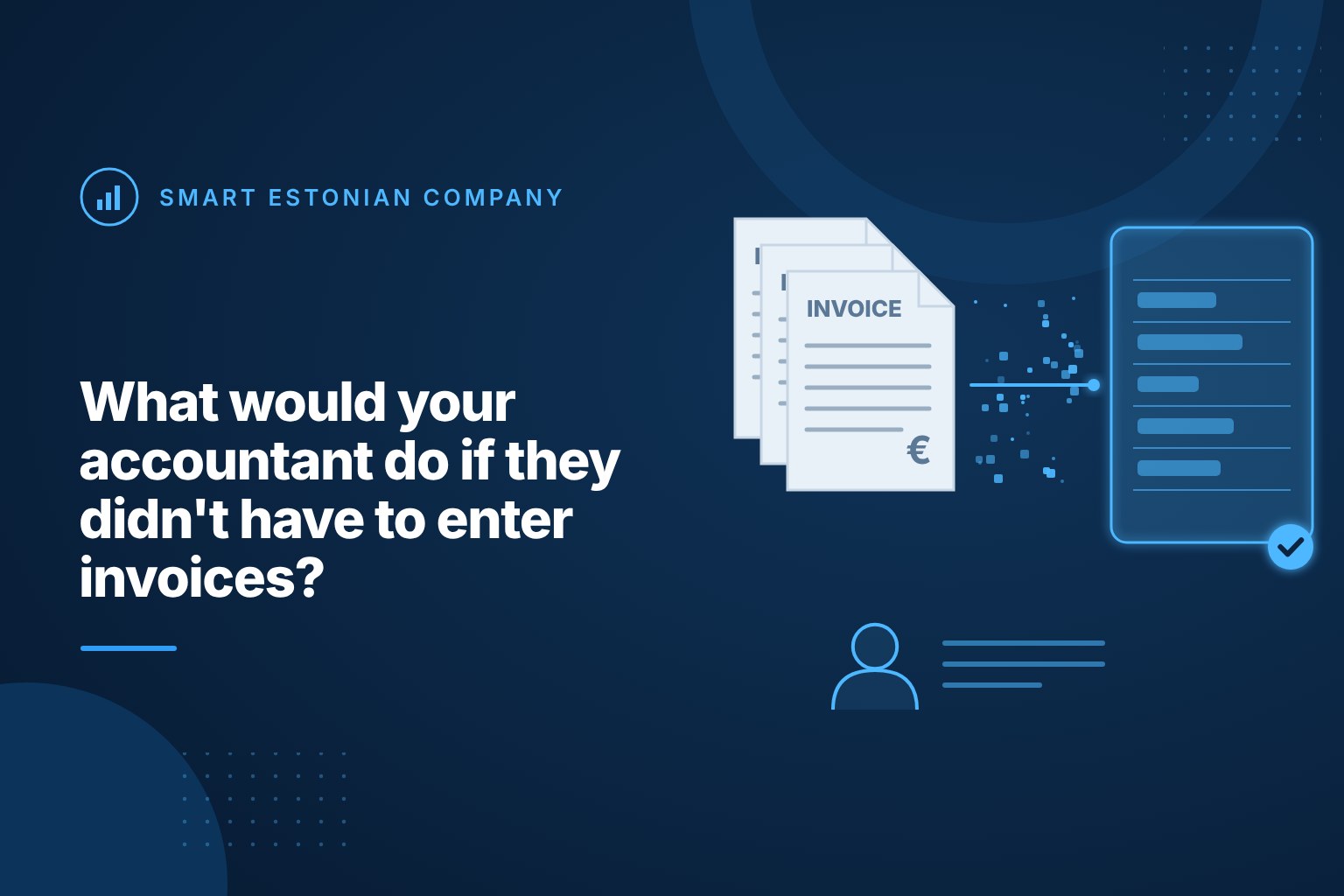
Invoice digitalisation is an area where nothing needs to be developed from scratch. Existing services use AI to read all the key data from a PDF invoice: supplier, amounts, VAT, due date, invoice lines with products and quantities.
In practice it works like this: an invoice that arrives as a PDF is forwarded to a dedicated mailbox, the digitisation service processes it and creates a draft entry. The accountant reviews it, corrects it if needed and confirms it. About 99% of the data is read in automatically. There is practically no manual entry.
Estonia has several solutions that work well: Telema eFlow, CostPocket, Finbyte and others. Some business software, such as Odoo, Erply or Directo, already has invoice digitisation built in.
Sound familiar?
The accountant no longer retypes invoices. Their role changes from data entry to checking. They review whether the system has interpreted the invoice correctly and confirm the entry. Errors are a fraction of what they used to be, invoices get into the system faster, and the accountant can work on what they are actually qualified for.
Invoice digitalisation has been possible for years. And yet I still see companies where the accountant prints out invoices and enters them by hand. The solution exists. It’s just that nobody has looked at this process and asked: why are we still doing it this way?
Think about your own company: does your accountant print out invoices, or has their day already been freed from data entry?
Olga Luštšik advises companies on business process optimisation, digital transformation and the adoption of artificial intelligence.
Digiwise helps companies find the processes where digitalisation and AI deliver measurable results. If you want to know where your company has similar opportunities, start with a Digitalisation Roadmap.
Topics: accounting, automation
This article is part of the series “Smart Estonian Company”: practical stories from Estonian companies on their way to digitalisation.
← Previous: Why does your online store have fewer products than it should?