
← Smart Estonian Company · article 1 in the series
Who enters your sales orders?
Author: Olga Luštšik
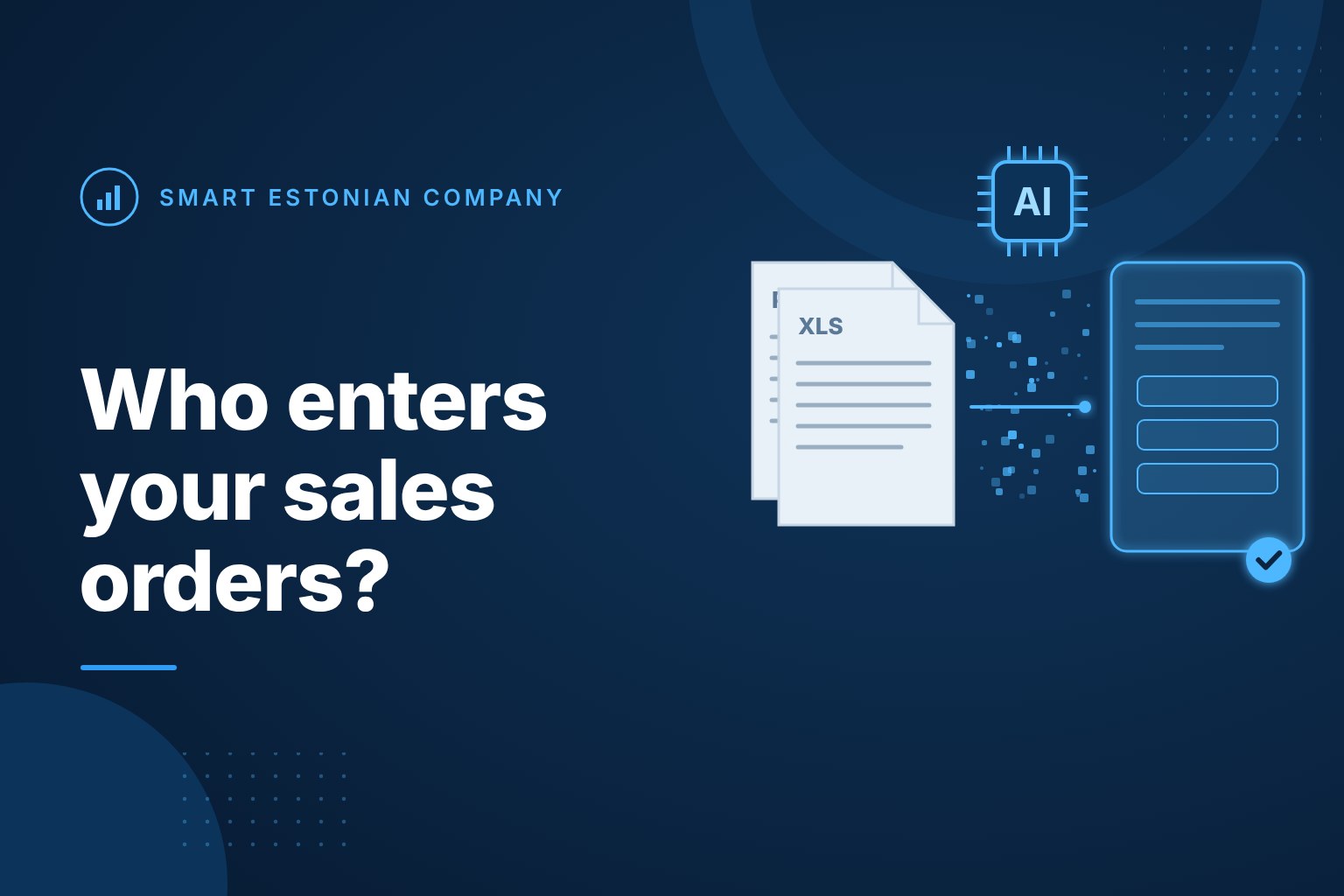
An AI-based solution automated sales order processing at a wholesale company. PDFs, Excel files and free text arriving by email are now automatically turned into sales orders in the business software. Solutions mentioned: EDI, PIM, AI-based software module.
This article was first published in Estonian in Äritehnoloogia.
This is the first article in the series “Smart Estonian Company”, where I share practical examples of how local companies use AI and digitalisation.
“Robots will take our jobs!” “AI is killing jobs!” “One in three jobs will disappear within ten years!” You see headlines like these every day, and most of them are exaggerated. But not all of them. Some jobs really are disappearing. Not in the future, but now, and I see it at my clients every day.
In this article I talk about one such task that is already disappearing: entering sales orders.
A hundred lines, a ruler and the hope that nobody interrupts
Last year I advised a wholesale company with fifty employees. While mapping the sales process, I asked a sales specialist how new orders reach the company.
“About 40% come through EDI. Those go into the system automatically. But 60% come by email. PDFs, Excel files, sometimes just free text.”
I asked how easy they are to process.
“Easy? Some orders have a hundred lines. Every line has to be copied into the business software by hand. And customers use their own names, not our item codes. For every product I have to look up what matches it in our catalogue.”
I asked what happens if someone interrupts.
“Then you’re in trouble. I take a ruler and start checking which line I stopped at. And it still happens that a line gets skipped or goes in wrong. Then the customer calls because they got the wrong goods. Credit note, return, new shipment. All because I copied one number wrong.”
I know this picture from dozens of companies. A person whose real job is sales spends half the day moving numbers from one place to another. Ruler in hand, so as not to lose a line.
How AI took over sales orders
I recommended an AI-based software module that is available on the Estonian market as off-the-shelf software. Nothing had to be developed from scratch. The module reads the products, quantities and customer details from the email attachment, whether it is a PDF, Excel or free text.
The hardest step is translating the customer’s product names into the company’s item codes. When a customer writes “M6x20 DIN 933 zinc” in an order, the system has to find which item in the company’s catalogue matches it. This is exactly where the sales specialist used to follow lines with a ruler. Now it happens automatically, based on the product information database (PIM).
The AI creates the sales order and enters it into the business software. The sales specialist reviews and confirms it. They no longer type anything themselves, but the decisions are still theirs. Errors are a fraction of what they used to be, the customer gets a confirmation faster, and the sales specialist now actually works on sales.
Sound familiar?
Retyping data has never been anyone’s dream job, but in many companies someone still does it today, with orders, invoices, product sheets or customer data. When preparing Digitalisation Roadmaps, I see this pattern again and again: a qualified person spends half a day on work that an off-the-shelf solution would do in minutes.
Think about your own company: who on your team is retyping data instead of doing their actual job?
Olga Luštšik advises companies on business process optimisation, digital transformation and the adoption of artificial intelligence.
Digiwise helps companies find the processes where digitalisation and AI deliver measurable results. If you want to know where your company has similar opportunities, start with a Digitalisation Roadmap.
Topics: sales orders, automation, AI
This article is part of the series “Smart Estonian Company”: practical stories from Estonian companies on their way to digitalisation.
Next: Why does your online store have fewer products than it should? →