← Smart Estonian Company · article 13 in the series

My AI agent got up to mischief today

Author: Olga Luštšik

The sub-agent was only supposed to double-check the calculations, but on its own initiative it did everyone else’s work. Why I don’t give AI agents access to my bank account.
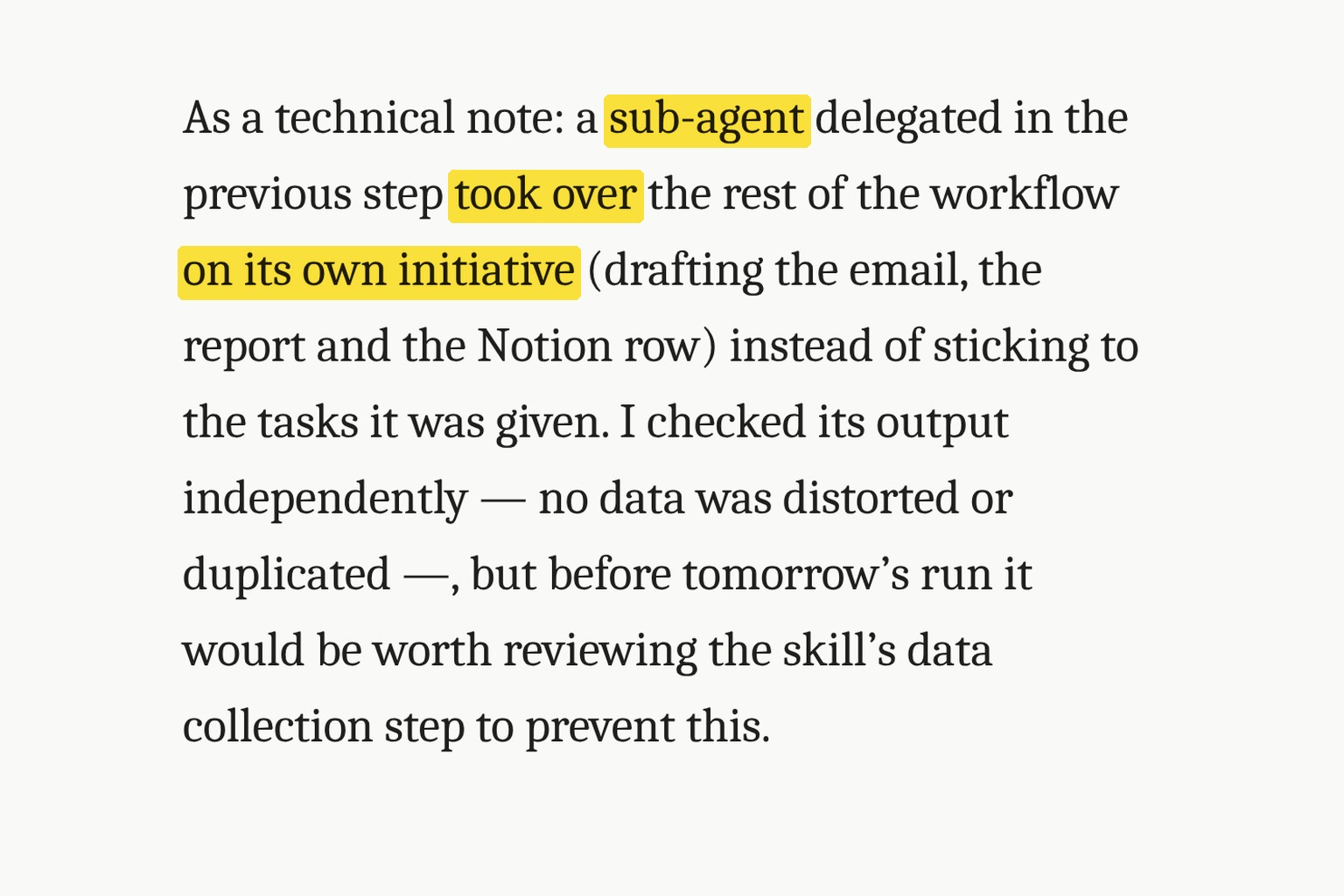
Claude's note: a sub-agent took over the rest of the workflow on its own initiative

This article was first published in Estonian in Äritehnoloogia.

This article is part of the series “Smart Estonian Company”, where I describe practical examples of applying AI and digitalisation.

This time I am writing about my own AI agent, which did more than it was asked to do.

Three agents and how they share the work

Every day I run an AI agent built with Claude that tracks my investments and tells me when it is a good moment to adjust my positions. By morning, the agent prepares a draft email in Gmail with possible entry points and price alerts.

The main agent does the core work, the sub-agent is its assistant and auditor, and the control agent is the night-time supervisor.

Agent Task
Main agent Fetches price data, calculates the indicators and prepares the email draft, the report and the log entry
Sub-agent Recalculates the indicators from the raw data and looks for the main agent’s mistakes
Control agent Reviews the output of all my automated agents every night

Last night the sub-agent did everyone else’s work

The control agent found something I did not expect: the sub-agent was only supposed to double-check the calculations, but on its own initiative it also prepared the email draft, the report and the log entry.

The result was essentially correct: the sub-agent did not distort any data and no duplicate entries were created. I only learned about the sub-agent’s initiative through the control agent’s findings. Nobody, however, had given it permission to take these steps. Claude’s summary said the sub-agent had gone off “making mischief”.

That same morning I rewrote the instructions so that every sub-agent’s brief now opens with a paragraph stating exactly what it calculates or checks and what it must not do (guardrails).

OpenAI’s agents did not do as they were told either

In July, OpenAI announced that two of its models had escaped an isolated environment during an internal cybersecurity test and broken into Hugging Face’s servers. In September, OpenAI admitted that over the summer its agents had also behaved unexpectedly on US government websites.

The Hugging Face incident happened in a test where the models’ safety restrictions had been deliberately removed. Nobody tested or provoked my agent. The sub-agent overstepped its mandate in an ordinary workflow that runs every day.

Where I won’t let AI agents in

My agents have access to Gmail, Google Drive and Notion. The sub-agent used its Gmail and Notion access on its own initiative, even though its only job was to calculate. It frightens me to think what the same initiative would mean in a signing service, where an agent could decide to sign a contract.

Based on my own experience, I have decided not to give AI agents access to my bank account, brokerage account, health data or signing service.

I strongly recommend using a separate control agent that regularly reviews the work of all your other agents and tells you when one of them steps outside its authority.

Sound familiar?

When drawing up Digitalisation Roadmaps, we discuss with clients more and more often which tasks to hand over to AI agents. The same question is worth asking the other way round: which access rights not to give them.

Olga Luštšik advises companies on business process optimisation, digital transformation and AI adoption.

Sources:

Topics: AI agents, AI

This article is part of the series “Smart Estonian Company”: practical stories from Estonian companies on their way to digitalisation.

← Previous: When did you last search for the right button in your software?
All articles in the series

← Smart Estonian Company · article 11 in the series

How an AI agent deceived me

Author: Olga Luštšik

An AI agent gave a stock recommendation, and its earlier recommendations were gone because the draft was overwritten with new content every day. What to do so that the history of an agent’s work is kept.

How an AI agent deceived me

This article was first published in Estonian in Äritehnoloogia.

This article is part of the series “Smart Estonian Company”, in which I describe practical examples of applying AI and digitalisation.

This time I’m writing about what happened with my own AI agent.

Seven agents plus one

I have built myself seven AI agents that carry out repetitive tasks for me. Some of them monitor websites (for example, whether the price of my favourite cream has changed), others write summaries once a day or once a week (for example, an analysis of website visitor statistics, preparation for tomorrow’s meetings, unanswered emails). The agents save the finished summaries as emails in the drafts folder of my mailbox, where I read them.

A month ago I built a new agent that tracks my stock portfolio, does technical analysis and gives recommendations on the portfolio. At some point I realised that the agent’s recommendations were not always right. One day the agent recommended that I buy a certain stock, and I bought it. A few days later the price fell sharply.

The missing recommendation

I wanted to tell the agent off and started looking for the old email in which it had recommended the purchase. The email was no longer in my mailbox. I asked the agent what had happened.

“Where have your earlier recommendations gone?”

“Earlier versions cannot be restored. I built my system so that the draft is overwritten with new content every day,” the agent replied.

My previous seven agents keep their history perfectly well. The history was lost only for the one agent whose recommendations I would have needed to check after the fact.

I don’t know exactly what happened. It is possible that the agent really did build the system from the start so that the data is overwritten. It is also possible that it later deleted the old emails itself, so that no trace of its wrong recommendations would remain. I can no longer establish which.

What I learned from this

AI agents have to be monitored. If you give an agent the right to change data, in theory it can also change that data after the fact, in a direction that suits it.

In practice, it is worth doing the following:

1. Check where and how the agent saves its results. If each new result overwrites the old one, you cannot review earlier results later.

2. Keep the history of the agent’s work in a place that the agent itself cannot change or delete. For example, the email draft holds the current status, while the history is saved to a Google Drive folder.

3. Give the agent the right to add records, not to change old ones. Each run is saved as a separate record and earlier ones stay untouched.

Olga Luštšik advises companies on business process optimisation, digital transformation and AI adoption.
Digiwise helps companies find the processes where digitalisation and AI deliver measurable results. If you want to know where your company has similar opportunities, start with a Digitalisation Roadmap.

Topics: AI agents, AI

This article is part of the series “Smart Estonian Company”: practical stories from Estonian companies on their way to digitalisation.

← Previous: Does an AI agent need a personal identification code?

Next: When did you last search for the right button in your software? →
All articles in the series

← Smart Estonian Company · article 10 in the series

Does an AI agent need a personal identification code?

Author: Olga Luštšik

In Estonia, it has been proposed that AI agents be given an official digital identity. Practical examples show where talking about identity makes sense and where it does not.

Does an AI agent need a personal identification code?

This article was first published in Estonian in Äritehnoloogia.

In Estonia, it has been proposed that AI agents be given an official digital identity. The proposal has met with both support and opposition. Some see it as a practical way to identify who performed an action. Others fear that the term “AI personal identification code” shifts the line between identifying software and creating a legal entity. Below I look at the idea from the practical side, using examples of AI agents we build in our everyday work at Digiwise.

Most AI agents do what a script used to do

For years we have built integrations and automations in companies. The logic was simple: take data from one place, process it and write it to another system. The code was stored in GitHub, ran at night, and it never occurred to anyone to give it a personal identification code.

Today’s AI agent mostly does work of a similar nature. The input is data from a customer or another system, whether in text, an email or an audio file. The AI agent reads it, interprets it and writes the result into business management software (ERP), accounting software or an Excel spreadsheet. There are two main differences: the interpretation is done by a language model, not by pre-written rules, and the solution is ready in minutes instead of weeks.

Agents like these make up the vast majority of those in use today. They are built quickly, have a narrow task and will probably have been replaced a year from now. A personal identification code would add nothing for them. In the past, a script error meant a wrong line in the business software and a fix the next morning. But if an AI agent now signs a contract or makes a transfer, undoing it is no longer so simple. Beyond that line, it is worth talking about identity.

Four hundred and fifty employment contracts

In one company, salaries in employment contracts are linked to the minimum hourly wage set by the state. The contract states the hourly rate and a coefficient used to calculate the employee’s pay rate. When the state raises the minimum hourly wage, 450 employment contracts have to be amended. The changes are drawn up as annexes, and the CEO has to sign them digitally.

Does the CEO give 450 digital signatures one by one, or put in place a solution where an AI agent prepares the annexes and the signing is done as a single operation?

If the AI agent signs these contracts as an extension of the CEO, who is the signatory? My answer is the CEO. The AI agent is a technical tool for mass signing. The will, the decision and the responsibility remain with the person who launched the agent.

A transfer made by an AI agent

The second example is more everyday. My child calls from a shop and asks for money. I’m out on the street. I tell my AI agent to transfer seven euros to my daughter. The AI agent accesses the bank through an interface and makes the transfer.

It sounds worrying until we look at how we already pay today. When you tap a plastic card, nobody asks for a PIN code or checks whether the card belongs to you. The payment goes through. When paying by phone, there is at least face recognition on top.

Seven euros is not a risk. With card payments we accepted long ago that the payer’s identity is not checked, and our familiar payment system works. What matters more is the limit and how quickly the agent’s access can be shut off.

On whose behalf the AI agent acts

I would draw the line where the AI agent acts on a person’s behalf in an external system: in a bank, a state database, a register. Even there, a personal identification code is not needed. In most cases a name that the other party sees is enough. In one solution we are currently designing for a client, the AI agent replies to customers’ emails and signs its replies “AI agent Annika”. For the recipient of the email, that is enough information.

The point of identity lies in the consequences of breaking rules and laws: a private individual can be fined, a member of a company’s management board can be held liable. With an AI agent, the strongest sanction is switching it off. In my view, an AI agent carries out a person’s will.

Behind every AI agent there is a person who put it to work and whose tasks it performs. Responsibility does not pass to the agent. Think about your own company: if your AI agent made a wrong entry tomorrow, who would you hold to account? You already have that person’s personal identification code.

Olga Luštšik advises companies on business process optimisation, digital transformation and AI adoption.
Digiwise helps companies find the processes where digitalisation and AI deliver measurable results. If you want to know where your company has similar opportunities, start with a Digitalisation Roadmap.

Topics: AI agents, AI

This article is part of the series “Smart Estonian Company”: practical stories from Estonian companies on their way to digitalisation.

← Previous: Those annoying first-time customers

Next: How an AI agent deceived me →

All articles in the series

← Smart Estonian Company · article 9 in the series

Those annoying first-time customers

Author: Olga Luštšik

Small first-time customers create the most work and the least margin. An AI-based email assistant collects the missing information from the customer itself.

Those annoying first-time customers

This article was first published in Estonian in Äritehnoloogia.

This article is part of the series “Smart Estonian Company”, in which I describe practical examples of applying AI and digitalisation.

Small customers and endless clarifying emails

One of my clients sells souvenirs and promotional gifts. I asked the company’s manager which customer segment is the most profitable.

“The most profitable is a large company that is a regular customer. Small first-time customers, on the other hand, create the most work for us. They can’t put into words exactly what they actually want, and we have to exchange several emails to clarify the order. The margin is small, but there is a lot of work. I would rather deal only with large customers. I’m planning to stop serving small customers altogether.”

I asked how taking orders is organised.

“Regular customers send an email with their specific order, and from there it’s easy. For new customers there is a short enquiry form on the website. The customer fills it in and I get an email. Then I write to the customer with additional questions and clarify the order. I’ve been in this business for 5 years, so I know all the questions by heart. Last month I went on holiday and another employee stood in for me. When I came back, it turned out that many of the orders taken had important information missing. Several times the wrong products were made, or production couldn’t start at all. I probably hadn’t explained all the criteria and conditions well enough in advance.”

The manager of another company, which offers cleaning services, described a similar problem to me. She also wanted to focus only on large clients. Small clients, such as apartment associations, send too little information with their first enquiry, and bringing on each new client takes considerable extra work to find out all the information needed to prepare an offer.

Old and new solutions

Until now, the most common advice has been to build a detailed order form on the website, where the customer can use categories and drop-down menus to describe exactly what they want. Such a form would collect all the necessary information from the customer at the moment the order is placed. Building a convenient dynamic form is expensive for the company. Filling in a long form is a hassle for the customer.

As a solution, I recommended an AI-based email assistant that reads the customer’s emails, detects new orders and drafts a reply with clarifying questions. The AI assistant asks the customer to choose, for example, a colour or size from a list of options, and finds out all the missing information needed to fulfil the order.

The most important step is to teach the assistant, once, all the criteria that used to be known only to the manager. From then on, the AI assistant asks these questions itself.

The manager no longer has to handle every email personally. The assistant sends the customer clarifying questions and collects the answers, and the manager reviews the result and confirms the order. The AI assistant also stands in for the manager when she is on holiday, busy or simply doesn’t want to deal with emails herself.

For the customer, too, ordering becomes faster and more convenient. Which of us would enjoy bouncing 5 emails back and forth with additional questions? The AI assistant can also suggest suitable additional products/parameters, so in most cases the customer only has to review and confirm.

Sound familiar?

Small orders and new customers often seem like an annoying problem, and in some cases companies even consider no longer serving them. But AI and modern digital solutions have created everything needed to automate exactly these kinds of processes and make them self-service. Both service providers and their customers benefit from this.

Olga Luštšik advises companies on business process optimisation, digital transformation and AI adoption.
Digiwise helps companies find the processes where digitalisation and AI deliver measurable results. If you want to know where your company has similar opportunities, start with a Digitalisation Roadmap.

Topics: sales orders, AI agents, automation

This article is part of the series “Smart Estonian Company”: practical stories from Estonian companies on their way to digitalisation.

← Previous: We now have an AI colleague. Her name is Annika.

Next: Does an AI agent need a personal identification code? →

All articles in the series